Back in the early forties, neighbor Elma Lue Case and her family lived in the Dave Appel house on Willow Creek where part of their income came from a small herd of milk cows. But the milking arrangement was less than ideal for a mom with young kids. The milking barn was down toward the creek and the milk house was about two hundred yards up the hill behind the main house. So, Elma Lue would haul buckets of milk up the hill, twice a day, oftentimes with a hefty baby boy slung on one hip. I imagine the trips were made in the dark for most of the year. A lantern would have hung in the barn and one would have been waiting in the milk house.
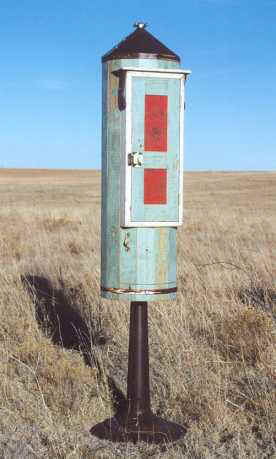
The WILLOW CREEK LANTERN CABINET is dedicated to all those milk runs Elma Lue made and to her good humor and bright spirit.
The “lantern” part of the cabinet is formed from a hammer mill screen, and a door grill out of a wood stove from Denver. The mica comes from North Carolina. Split into thin sheets, it was then heated to conform to the curves of the hardware.
All of the wood and door hardware was salvaged from the old Appel house. When we pried loose the door and window trim and baseboards we found pieces of tin underneath the wallpaper, nailed over knot holes, cracks, and rat holes. We soon discovered that the tin patches were made from Royal Crown Cola and Nehi signs, all dated 1936.

The old wooden railroad water tanks are all gone now. The memory of their silent presence and half of a Model-T differential that looked like it should be the base for something were the inspirations for the tower cabinet.
The blue coopered boards were once car siding on the kitchen ceiling of the Hostutler homestead. The boards were hidden on the kitchen side by several layers of wallpaper and on the attic side by a layer of 30’s and 50’s dust. The white door frame came from baseboard salvaged out of the front room.
A discarded hog feeder provided tin for the door panels. The roof was formed with a scrap of tin from an old storm cellar door. The door latch was a kitchen cabinet latch in Tom Conatser’s house, just north of the Canadian River in Hemphill County. And the bottom door pull was once a double-hung window catch.
The brass “heart” was a buckle cover for light duty harness.
Clear from Denver, the bathtub griffin claw feet were part of a load of “gift” cast iron pieces and parts. They hung on my hardware wall for over a year. Too strange a shape to use, and too hard to mount on anything but a bathtub.
Then, from a friend who lives south of us across the Canadian River and fourteen cattle guards from town, came the ball and claw table legs and old lamp finial. All four legs and unbroken as well.
About that same time I happened on a load of gumwood in Canadian, Texas, that had been stored over forty years. Considered a substandard wood, no one else wanted the gum.
Months later while salvaging the Dave Appel house in Lipscomb County, Texas, ceiling beadboards with the original dark milk stain were discovered under layers of wallpaper and printed chicken feed sack material. On The Way To Kingdom Come was on its way.
Complete with hail dents, aluminum-painted tin from a shed on Sand Creek Ranch became “roof” and door panels for the dresser. And carriage bolts now serve as door and drawer pulls.

PLUM PICKER was inspired and built around a mysterious piece of castoff hardware discovered in a junk pile on Camp Creek Ranch in Lipscomb County, Texas. Someone years ago had punched a passel of holes in an old windmill sail and then framed it on three edges with 2×4’s, leaving the narrow end open. What was it? Some sort of ineffective grain screen? Neighbor Lloyd Fry, dependable junk identifier, knew right away. According to Lloyd, it was a plum screen. Folks used to be serious about picking wild sand plums. None of this, one plum at a time. They would grab a short cottonwood branch and thrash the ripe plums off the bushes by the bucketsful. Of course, that meant you wound up with considerable trash–leaves, twigs and the like–in with your plums. Hence, the plum picker’s screen.
The punched sail called for red backup tin. That comes from a salvaged barn and shed on the Shaller Ranch southeast of Canadian, Texas. The red tin needed a white–or almost white–door. Fencing boards from the Parker boarding house in Lipscomb filled the bill. White clapboards from the old Dave Appel house on Willow Creek now form the sides of the chest. A faint initial carved in a clapboard can be seen on the right side of the case and a broken-off knife point was left embedded in one of the boards. The backside of the boards showed evidence of many successful knife “sticks” before somebody pried sideways on the knife.
The frame of the chest is corral wood from the old corral on Sand Creek Ranch. Red “patches” show where posts protected the once all-over-red boards from weathering. Red edges were on the more protected underside of the boards.
To be finished out, PLUM PICKER had to have a proper picker crown made from a sweep plow picker wheel.

Big concrete elevators at the main rail centers and the changing ways of agriculture have eliminated the need for the old wooden elevators. Seldom noticed standing by the tracks in small towns, and too tough to tear down, the wooden elevator still remains a plains icon.
Inspired by that familiar outline, the SOUTHERN PLAINS SENTINEL cabinet is built of salvage trim and floorings from the Peg Robertson place located south of the Washita in Hemphill County, Texas, Red River Wars country. Peg was so named because he had lost a leg as the result of a rattlesnake bite when he was about seven years old. Peg passed on years ago and his old house was due to be burned and replaced by a new cabin. When we showed up to start salvaging what we could of the house, we were greeted by Peg’s old wooden leg, complete with weathered cowboy boot. That seemed to set the tone for the rest of the job, as one odd or humorous happening after another came our way.
In the Canadian and Mobeetie area Peg was known as quite a weekend rounder. So I was pleased to be able to validate the stories when we discovered an old whiskey bottle underneath the red flooring in a bedroom. The bottle was on its side lying on a ledger board that could be reached from the backside of the house. Parts of those heart pine floorboards are the red side panels and base for the cabinet.
The blue lumber for the doors and cabinet case was car siding hidden under wallpaper on the front room walls. At one point, while prying the boards from the studs, I heard a noise behind me. Turning around, I was face to face with a disturbed bullsnake that was hanging out of a hole in the ceiling.
Green window trim became drawer fronts. Door and “roof” panels were cut from door panels on a 1950 Chevy. Fender bolts from the Chevy and other odd cars are now door pulls. The butterfly hinges were salvaged from the Dreyfoos Schoolhouse kitchen.
The discovery side doors hold bits of castoff picture frames from the old Owens place in Lipscomb, Texas. The paintings the frames once held are long gone and the subject matter can only be guessed at. Unlike the wild tales about Peg that paint a vivid picture of what the old rounder was like.
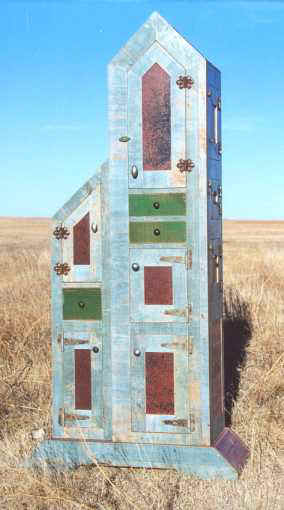
The last scraps of the barn siding from the Half Circle Ranch granary barn needed to be used in a special way. Though the termites had turned most of the siding into paper with a layer of red paint on one side, some of the salvage wood up under the eaves was solid.
Tin for the top inlay and the cabinet base once covered the north side of the old barn on our place. My late father-in-law had tacked the light gauge tin up in the mid-fifties in an attempt to slow the weathering of the north barn wall. The years have given the tin a fine patina, but a lot of nails have worked loose as well.
The strap handle came from the inside struts on the wheel of a six-foot Dempster windmill. The worn out mill once pumped a shallow well on a quarter of land we called Aunt Pearl’s Place.

The old buildings can be found on Main streets throughout the Southern Plains. Past their glory days, with peeling paint and faded signs, they still have amazing stories to tell, and will give up a surprise or two for those willing to give them a second look. Those grand storefronts and buildings inspired the Main Street Dreams Wall Cabinet.
The wood for the cabinet was once siding and trim on the back of the old Springer house near Boggy creek in Hemphill County, Texas. Mr. Springer’s first house on the site was a vertical log cabin that also served as store and post office in 1875. A couple of years later Springer and his hired hand were shot to death by soldiers possibly angered by a card game gone bad.
The green door panels are pieces of roof tin from the Tyson Ranch in Lipscomb County, Texas. Boone Tyson, who established the ranch, was raised by his grandparents, Mr. and Mrs. Boone. When the Boones first settled along Willow Creek in Lipscomb County, times were hard. If Grandma Boone needed milk for her children, she would saddle up, ride out and rope a range cow, milk the cow and then head back with milk for her family.
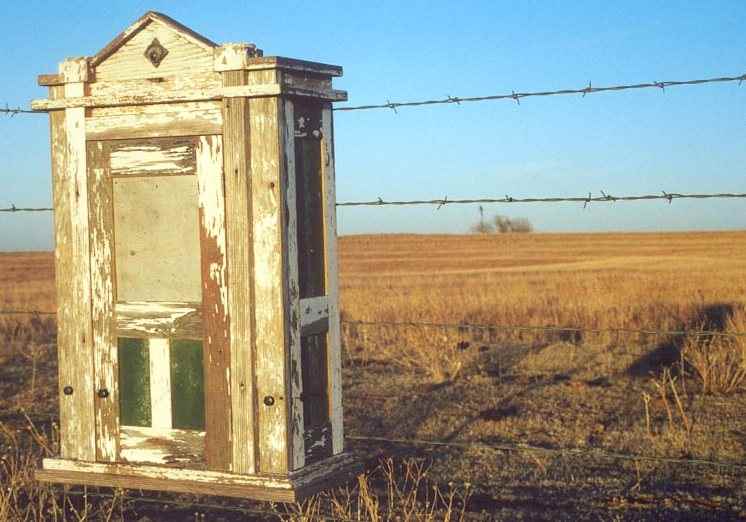
High atop the grain elevators of the Great Plains sit the headhouses- stacked boxy structures with spare dusty windows, squinting out over the vast spread of land.
The top of Headhouse Bookcase is banded by a section of combine elevator chain. Oak binder slats from Colorado serve as “mid tower” book stops. Yellow side panels were once flooring in a house north of the Washita River in Hemphill County, Texas. All the other salvage wood came from Peg Robertson’s place located south of the Washita. Peg obviously liked bright colors. The red framing of the bookcase and the “yellow door” hardware came from old bedroom doors. The bright blue door and window trim in that bedroom became accent trim on the bookcase. Buckshot is still lodged in some of the trim pieces. Peg may have had a real “critter problem” at one time. Tin patches were also nailed over gnawed places at the bottom corners of the doors.

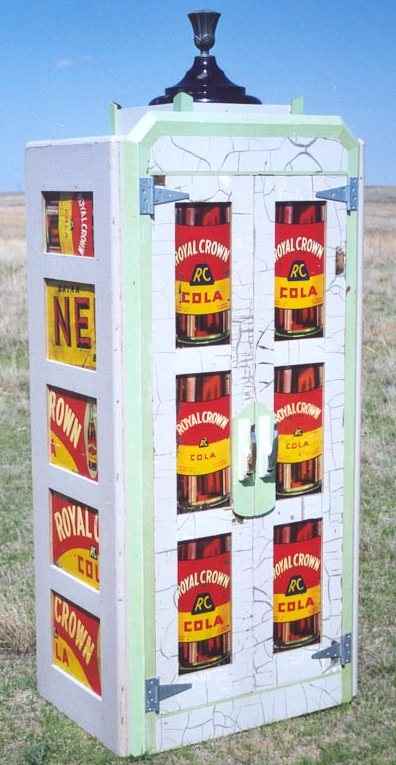
The door and window trim and the baseboard with the gray crackled paint appeared to be the main prize of the salvage job on the Appel house. But the old house on Willow Creek had some surprises hidden from view. As more of the trim was pried loose, we began to notice patches of tin with bright colors shining through the accumulated layers of wallpaper. More scraping with the pry bars revealed portions of old Royal Crown and Nehi signs (copyright 1936) nailed over knotholes, rat holes, and cracks all through the interior of the house. Only one whole bottle-shaped sign could be found. All the rest had been snipped in two.
After two days of cleaning and flattening, the old signs began to look fairly presentable. The idea for the RC Tall Chest began to take shape. Parts of the gray crackled doors and casing seemed like a fitting frame for the tin signs. Bright green accent trim is salvage wood from a little house in Higgins, Texas, which once served as an office for an overnight wagon court. More than likely, the green paint dates from the early ‘60’s.
A couple of castoff Servel gas refrigerators found in sheds out behind the Hotel Higgins provided handles for the RC Tall Chest doors. And a Denver street light bonnet is now the top finial.
The years of drifting sand had just about covered the remains of the old farm wagon on Dugout Creek north of Lipscomb, Texas. Only the hardware and parts of the axles on the undercarriage remained. The fifth wheel pivot plate stood out because of its unusual shape. Long brace ears, cast as part of the pivot, extended out to each side. The idea for the basic shape of the Center Bound Reliquary started with that fifth wheel plate.
Suitable legs for the reliquary came along in the original form of oak corral boards from the Shaller Ranch south of the Canadian River. The stout old boards had withstood many years of charging cows or packed steers. Unfortunately though, the posts the boards were nailed to were not as stout and most were broken off or leaning over, so the corral had to come down.
Wood for the reliquary case is cut from a small number of usable siding boards salvaged from the Half Circle Ranch granary barn. From the outside of the barn the siding looked fine, but termites had traveled up most of the studs turning the siding to dust on the inside. Turquoise accent trim comes from door and window trim left over from the remodel of the old Parker boarding house in Lipscomb. Nails pulled out of the trim were square-headed, cut nails. The turquoise paint most likely dates from the 50’s or 60’s.
Inside the reliquary, parts of an old picture frame from another Lipscomb house create a border for a piece of barn tin. And a brass buckle cover on a section of windmill chain hangs in front of some sort of flattened serving tray. The tray’s color and texture made it stand out and saved it from the general clutter of another abandoned homestead.
The top finials are riser bushings from the Dugout Creek wagon undercarriage. And of course, lowly baling wire binds it all together.
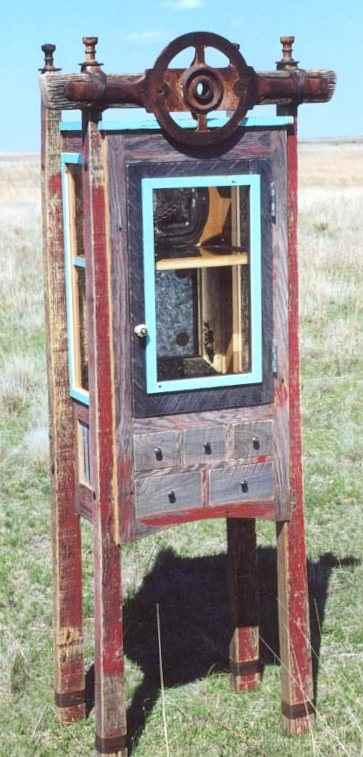
Four steel go-devil points were the inspiration for the Go-Devil Reliquary. Buck rakes or “go-devils” were horse-drawn implements used to stack or “buck” hay and feed, The nine-foot long wooden pikes or tines on the rake were tipped with the pointed steel shoes.
Legs for the reliquary are cut from short rafter boards, salvaged one clear, cold January day from the Half Circle Ranch granary barn. Blonde “ghost” marks from the brace boards show near the top of the legs.
The case parts are cut from shiplap boards of southern longleaf pine discovered under layers of wallpaper and patches made from RC Cola signs; the boards sheathed the interior walls of the Appel house on Willow Creek near Lipscomb, Texas. Judging from the samples of children’s pencil scrawl visible on the original boards about knee-high off the floor, the Appel family must have lived with the bare pine walls for a few years before they were able to wallpaper.
By the time salvage work started on Peg Robertson’s old house south of the Washita River in Hemphill County, Texas, the kitchen part of the house was in bad shape. Inside some of the remaining cabinets, though, were some bright blue shelves and door panels, untouched by water and weather. The trim and back panel for the Go-Devil Reliquary is made from those protected cabinet interiors.
Smashed, parking lot bottle caps secure the back panel. The gilded molding is part of a large frame that came out of New York City, framing a 19th century French painting.

Some of the last trim boards from the old Hill place on Dugout Creek near Lipscomb, Texas, provided enough material for the face frame on the wall cabinet. Teams of horses moved the Hill house from Timms City on the old Dodge trail. When the railroads came through and freight traffic on the trail came to a halt, all the buildings in Timms City were hauled off to various parts of the northern Texas Panhandle. Also coming from a trim board in the Hill house, the blue cabinet top was probably from a later addition, after the house was in use on Dugout.
The green side tin once roofed corral sheds on the Tyson Ranch on Willow Creek. Blue door panels were cut from a 55-gallon antifreeze barrel. Door frames are made from heart pine flooring left over from a remodel of a little ranch house south of Canadian, Texas. Banding on the doors is fastened with smashed bottle caps collected from beer store and Dairy Queen parking lots. Upside down, stove leg corner brackets once supported a small gas heater in the Hotel Higgins, Higgins, Texas.
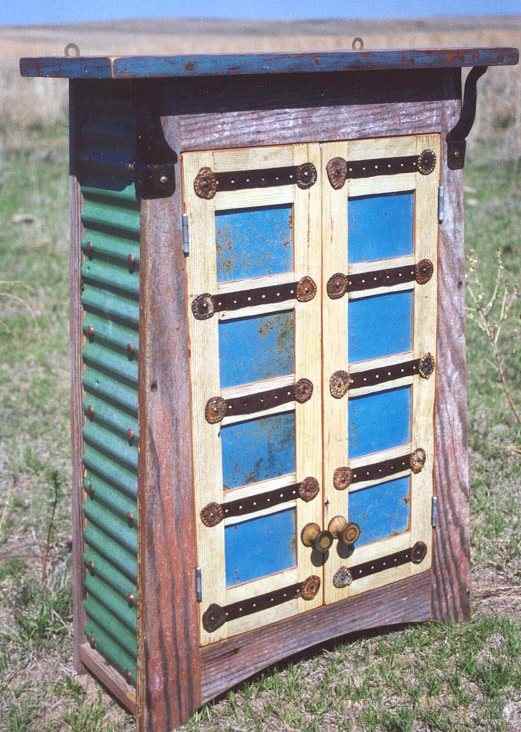
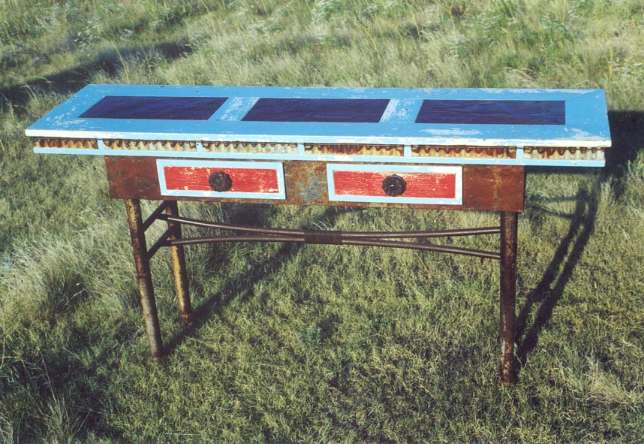
For more years than any of us could remember, the six-foot Dempster windmill had faithfully pumped water on Aunt Pearl’s place. Due to spreading rust-out places on the old pitted pipe tower, a new tower was in order. The Little Dempster Hall Table legs are cut from the lower portions of the old tower where a fine patina of sorts had formed from the rubbing of cattle and blowing sand. Table braces are made from hay rake tines and oil field sucker rods.
Up on top, the table frame is made of parts of a large plantation shutter from a home in Fort Worth. Rips from the shutter slats make up the drawer fronts.
Tin table panels and box cladding once covered part of the north side of the old Bucher barn on our place in Lipscomb, County, Texas. The tin had been nailed up in the ‘50’s to try and protect the barn wood from the driving north wind. Sad to say, termites went after the wood then from the inside, the nails lost their hold and the north wind peeled off the tin.

Planted in a scrap pile on the Brown place near Ballinger, Texas, the ‘30’s-era coal-burning heater had not been bothered for years. But this winter it went on quite a journey before becoming the main inspiration for the Ballinger Bureau. Roy Brown and his dad figured I needed that stove. So Roy hauled it to his home near Ruidoso, New Mexico, and on to Taos where we rendezvoused with him. We then took the stove back to our place up in the corner of the Texas Panhandle. (Mind you, this was not a lightweight stove, and every loading and unloading carried the potential for lasting bodily harm.) Roundabout journey complete, the stove sat by my own scrap pile and seemed to stare at me. Time to take up the cutting torch. The Bureau was underway.
Ironically, the interior portion of the stove, with the narrow firebox on the bottom and the larger top heat chamber, was takeoff point for the design of the bureau. From the stove’s exterior cabinet, the top grill became the bureau’s base, the bottom heat grill–with the addition of green mica–became the tray support, and the center stoke door was given new hinges and a place on the bureau’s front. Tin heat shields on the back of the stove are now door panels.
White and yellow case wood is cut from door and base trim from the old Jones house in Higgins, Texas. It is said that the house is haunted. If true, the ghost(s) must be an easy-going sort, because no mishaps occurred during the salvage runs. We did discover a mostly full bottle of “internal liniment” stashed between the doorjamb and stud at the top of the basement stairs.
Wood for doors, drawer fronts, and side panels on the bureau comes from salvage trim in the old Springer house on Boggy Creek northwest of Canadian, Texas. Mr. Springer and a business partner are buried a few yards from the house. About 1878, soldiers–angry over a card game that didn’t turn out to their liking–shot them to death.
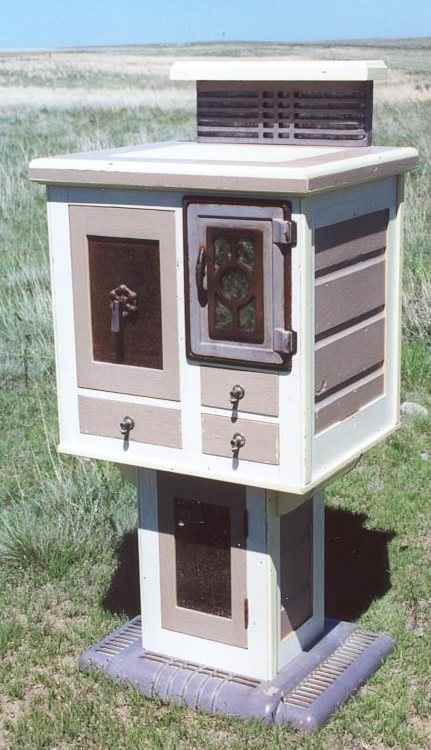
The auctioneer couldn’t get a bid on the old Hamilton upright piano. If nobody wanted it, the piano would get dumped over the creek bank. Drake couldn’t stand to see the waste, so he made a bid of ten dollars, making him the perplexed owner of a player piano with no player mechanism and worn-out workings, but a sound structure.
He solved his dilemma by giving me a call. Could I use a free piano? In a weak moment I gave a definite, strong answer of—well, I guess, sure. Beware of friends bearing free upright pianos. Drake had a clear conscience and I had a piano–a large, heavy piano that took up a fair amount of space. And it has a presence about it. Every time I went into the barn there was the silent player piano, just waiting.
Daughter Lindsay wanted to get started dismantling the old upright. No, I wasn’t ready to have more parts scattered all over the shop and the barn. But mostly, I had no ideas working for piano resurrection furniture. A year passed and I finally gave Debby the go-ahead to start. Buckets and stacks of parts later the Pianoforte Reliquary came into being. All of the hardware and the quartersawn oak used on the Reliquary came from the piano. A date of 1918, written in pencil, was discovered inside the piano case. The only money found was a lone 1940-penny with a hole punched in it. The penny now hangs inside the reliquary.
The reliquary case is made of recycled trim from the old Jones house in Higgins, Texas. A pink bathroom door provided enough wood for the legs. Amarillo newspapers dated 1938 were found under the sheet linoleum on the bathroom floor, so the house escaped any major damage in the April 9, 1947 tornado.

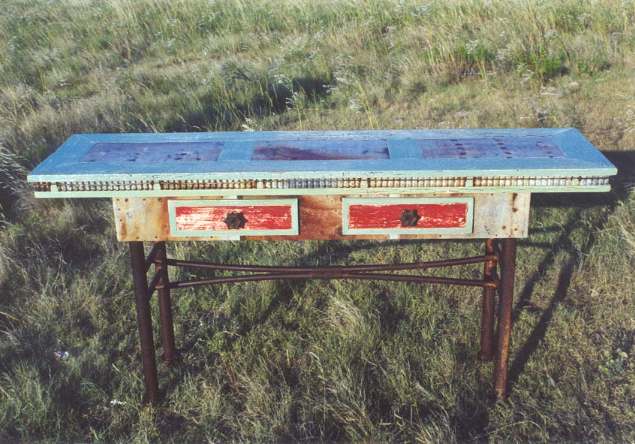
Like the husk of a giant beetle long dead, the picked-over and shot-up shell of the old threshing machine lay on the caprock overlooking the North Palo Duro Creek valley. Dribbling down the draw below the caprock were augers and various castoff thresher parts.
In a caring and thought-out effort to give an old ranch a second chance, the landowners were gathering the scattered junk on the place to a central resting-place. Hauled down the slope to a spot under a shade tree, the thresher body rendezvoused with a cutting torch and a second go-round of its own.
Some of the salvaged straw-walker conveyor fingers edge the Straw-Walker Serving Table. The light-gauge tin that the fingers ran on is now tabletop panels and cladding for the drawer case. Auger adjusting knobs have become drawer pulls. Table feet are recycled John Deere grain drill gears.
An abandoned house on a less-cared-for place a few miles south of Palo Duro Creek yielded door and window trim that have been reworked into the table top frame. Drawer fronts are cut from a trim board that framed the kitchen window in the old house. Trim near the ceiling had a dark, sooty appearance, the result of heating over the years with “sour gas.” Clothing from the 40’s and 50’s still hangs in the closets, unused by the family of barn owls that now inhabit the place.
(no description yet)

Since Anton Bucher’s old barn sits up on a hill south of Wolf Creek in Lipscomb County, Texas and since the wind is ever-present in the Texas Panhandle, the north side of the barn catches all sorts of weather from sandstorms to ice storms. During his years on the place Anton had made various patches and repairs to that north barn wall. In the fifties after Anton was gone, his son Frank, my future father-in-law, nailed light-gauge tin on the wall from roof peak to foundation in a mostly successful attempt to protect the wood siding. But almost fifty years later, the siding won’t hold nails anymore and the wind has started peeling sheets of tin from the wall. One of those loose sheets, the one from the corner by the feed room door, covers the drawer box and top panels of the North Wind Hall Table. The right-hand panel shows more polish than the others. That is because that section was nearer the ground and cattle, standing in the shade on hot days, would rub and scratch on that section of the wall.
Blue baseboard from Charlie Lynch’s place in Lipscomb has been reworked for the top frame. With a large stature, stern gaze and enormous, bushy eyebrows, Charlie kept all the kids in Lipscomb scared to death. When he and his compadres would play pitch, Charlie would–more often than not–declare that one of them was cheating and he was going to get his gun. But Charlie never shot anyone, and the group was usually back to playing pitch the next day.
Banding around the top is made of grain sieves from an old J.I. Case threshing machine. Adjusting knobs from the thresher’s auger are now drawer pulls. The red drawer fronts are made of window trim salvaged from an abandoned farmstead in Hutchinson County, Texas.
Stabbing skyward on opposite ends of the gable roof on the old frame house, the lightning rods symbolize the tension and family enmity that have settled dust-like over the abandoned farmstead out in the western Texas Panhandle. Two brothers, each convinced he will inherit the place from their old uncle, fight over who has control of the land. Meanwhile, the place slipped further and further into ruin; lines of worn-out, rusting machinery surround the house, outbuildings settled down into the weeds, and the unpainted house siding blows off like dry scales. Inside, the house is a place of uneasy ghosts, with old clothing still hanging in the closets, and barn owls in the attic.
The Ties That Bind Reliquary gives a second chance and some peace to parts of the old house and provides unity to the elements of tension. Lightning rod spires, cable, and brackets crown out the Reliquary. Green trim boards from the front rooms of the house are used for the case. Red kitchen trim and panels make the door and drawer fronts.
The Reliquary legs are cut from rafter boards salvaged out of a granary barn in the eastern Panhandle. Again, two brothers, one upset with the other for letting termites destroy most of the barn. Out of ruin and hard feelings, the roof rafters find wholeness in the Reliquary.

The old J.I. Case threshing machine had been scavenged for parts, used to sight in deer rifles, and scoured by sand from the storms of the 30’s and 50’s. Belly to the sky, the husk of the great machine lay at the edge of the caprock overlooking Palo Duro Creek in the northern Texas Panhandle. The dented shaft of the thresher’s auger could be seen poking out of a draw just below the caprock.
The shape of the No Place To Hide Tall Case is determined by the radius of the slide gate pulled from the inner ruins of the threshing machine. Cut from the main machine body, heavy gauge tin panels are now top, side, and door panels for the Tall Case. The faint outline of the upside-down J.I. Case emblem can be seen just above the bullet holes in the main door panel. The door latch hardware is reworked auger parts. On some of the smaller cast parts the Case “eagle on the globe” symbol is visible.
Several miles south of Palo Duro Creek sits the old Easley place. Lines of idle Case tractors and other odd machinery and cars surround the abandoned farmhouse. During World War II, the Easley brothers would dismantle a Case tractor and use the parts to keep a handful of tractors running. None of the little orange tractors plow the fields now. All are silent witnesses to the slow passing of the old house. Wind and weather whipping through paneless windows have given the interior trim a faded and crackled patina that is a perfect match for the thresher sheet metal on the tall case. A bedroom door, cut apart and reworked, has become the arch-topped door.

A forty-year-old stash of gumwood discovered in a shop in Canadian, Texas provided case wood for the High Gear Tower Cabinet and a suitable frame for tin panels cut from our old water barrel. The black 55-gallon drum had a screw-in spigot on top and we hauled it around for years to provide the water to set corner posts in concrete as we went about replacing the worn-out fencing on our place. High gear years. The water barrel had too many leaks and a round bottom– due to cold snaps that caught us with water still in the barrel. The main fences got rebuilt and the work crew thinned down. Time to give the old drum a second life.
A door of rough-sawn, oak corral board makes a good backdrop for an old shift lever found at the site of a long ago burned-out homestead.
White drawer fronts and trim are cut from a section of mopboard out of the old Hostutler house, just down the road from us. The Hostutlers set up housekeeping in their barn in 1908 while they built their home.
A couple of tines from Grandpa Bucher’s International Harvester “sulky” rake now serve as “springs” for the Tower Cabinet.

At first glance, trim in the old farmhouse hardly seemed worth salvaging. A thick layer of soot or film covered all the painted surfaces, especially near the ceiling. Did the old folks use a coal stove that sooted the place up, I asked? No, I was told, they heated with natural gas, tapping into a line that ran from a nearby gas well. But the gas was “sour gas,” and it was the poorly burned residue that coated the trim.
The boards did clean up and some of them are now the case of the Sulky Sideboard and frame the watery-looking galvanized panels that are cut from an old stock tank.
The lighter-gauge top panels are cut from sheets that were once liners for the straw-walker portion of a threshing machine. Tines from an International Harvester “sulky” hay rake now serve as tabletop supports. Rod keepers for the rake’s main beam have become door and drawer pulls. And the pivot brackets now support the top shelf with help from a short section of small gas well sucker rod.

Like an old chore coat, the north wall of the barn on the Bucher place in Lipscomb County, Texas has patches on patches. Unfortunately, there is not much of the old siding underneath that will hold a nail, so the fall and winter northers always manage to work a tin patch or two loose and send them flying into the corral or points further south. Gathered up and tossed into the granary, the patches added up, too fine in their rich rust and cattle-rubbed patina to throw away.
Patched back together, the scraps now frame the North Wind Mirror. Blue and red baseboard from Charlie Lynch’s house in Lipscomb trims out the frame. And frame corner brackets once braced gangs of grain sieves that ran along the pan in the straw-walker section of an old…?

The weathered farmhouse set in the clutch of elm trees is not the first thing you notice when driving up to the Easley place in Hutchinson County, Texas. The eye is drawn to the lines of used up machinery: orange Case tractors, grain trucks, cars, and a phalanx of combines. All are idle now, silent witnesses to the passing of the old house.
The story is told that Amoren Easley never did paint the exterior of the house. Five times his wife purchased paint, but he never got to the chore. So with siding like gray parchment and windows falling out of their casings, the house is no match for the years of Panhandle wind and weather. The blues and greens of the interior trim vary, depending on how exposed it is to the wind-path through the house. Crackled and bleached closet doors opened to reveal women’s clothing of the 40’s and 50’s, colors barely discernible under the dust.
A few miles north of the Easley place, Marilyn and Clarence Yanke are reclaiming an old ranch on north Palo Duro Creek. There the used up machinery is gathered and salvaged. Marilyn told me I had to take a look at the shell of an old threshing machine, that the beautiful rusty sheet metal needed to be put to good use.
When I saw the remains of the Case thresher, lying belly to the sky on the edge of the caprock overlooking the ranch, I knew the interior trim from the sad Easley farm house needed a second chance in tandem with the showy sheet metal.
Central to the design of the Thresher Chest, the main door panels show the faint outline of the upside-down J.I. Case emblem. Hardware from the auger is reworked to make the door latch. Parts of the “T” and angle iron of the thresher frame are welded for the base of the chest. Inside, the red drawer fronts are made of Easley kitchen trim.

Only half in jest, good neighbor Lloyd Fry says he is on the way to the dump, but decides to stop by my place first. Could I use some rusty chicken house roofing? You bet. Flat, with no rust-throughs, the colorful tin will work great. Lloyd drives off tinless, grinning and shaking his head.
The chicken house tin now clads the cabinet and flat panels of the Above the Roost Entry Table. Sections of a castoff pipe windmill tower serve as table legs. The old tower had stood on Aunt Pearl’s place for as long as any of us could remember. But the pipe got so pitted and thin that it was time for a new tower.
Door frames and drawer fronts are made from door and window trim salvaged from the Dave Appel house on Willow Creek in Lipscomb County, Texas. Pulls are worn brass spools from windmill well checks.
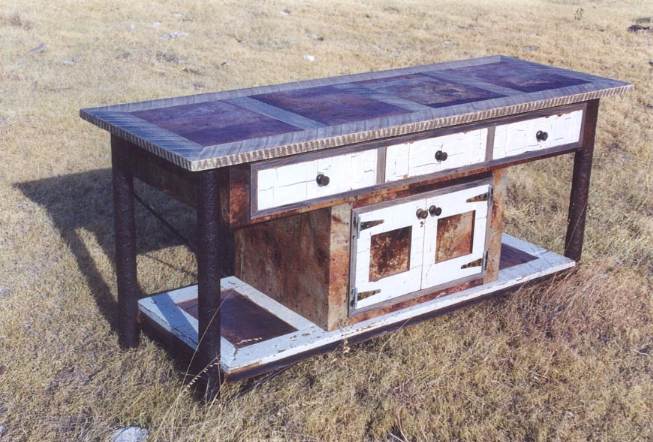
Years ago when area ranchers started feeding their cattle supplemental protein, the feed in the form of large sheets or slabs, was shipped in by rail. The cowboys called it “cake.” Loaded off onto wagons or trucks, the cake was hauled back to the ranches and stored in small, tin-clad buildings that were located near the various feed grounds. These isolated, utilitarian sheds, the “cake houses” are the inspiration for the Cake House Pantry.
Red roof tin on the pantry once sided a small feed shed on the Shaller Ranch southeast of Canadian, Texas. Most of the salvaged tin wasn’t worth much, courtesy of a leaky Aermotor windmill that slung oil all over the shed and corral every time the wind got up.
Green roof tin from the Tyson Ranch in Lipscomb County, Texas, becomes siding for the pantry case. Long before the green-roofed barns were built–when the Boone family was establishing the ranch–in order to get milk for her children, Grandma Boone would saddle up, ride out and rope a pasture cow to milk her out.
The rare (and flat) oak corral board determined the dimensions of the Cake House Pantry. The door pull is a trip lever from an International Harvester hay rake, also called a dump or sulky rake.
A few of the lonesome cake houses are still in use to store bags of cottonseed cube, still called “cake” in this area. But most of them are slowly leaning away from the strong winds and settling down to the ground, shedding sheets of tin like dry leaves.
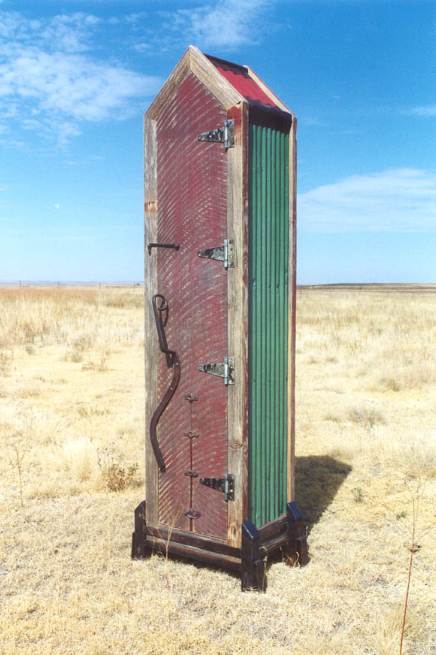
Clear in the back corner of the small barn stood the remains of a white kerosene cook stove. A lot of junk lay between the stove and daylight, but all the stove legs seemed sound. So up and over the junk it went. The bold printing on the oven door declared the stove to be a New Perfection.
Removed from the stove case and cleaned up, the legs are paired up with a cabinet case of gumwood for New Perfection Looking Glass. White corner trim from the old Jones house in Higgins, Texas, now works as glass stop. The door handle is the recycled oven door handle from the stove. A newer vintage stove found in the ruins of the Dreyfoos schoolhouse provided the control knob used on the turn button latch. Top corner brackets are legs from a small, open-flame gas heater used at one time in the Hotel Higgins. Each room had its own unvented heater. No two heaters were the same.
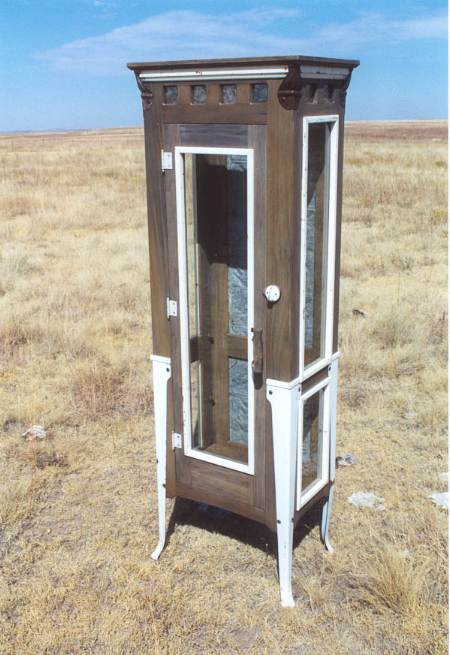
Having survived charging, mad momma cows and pens full of bawling calves, the weathered–but still stout–oak corral board headed for the salvage, a victim of rotted support posts and a new pipe corral. The straightest section of the weighty plank provided enough material for the top frame and drawer front of the Crowding Pen Hall Table.
The most daunting salvage chore at the old corral turned out to be the removal of the abandoned scale platform and framework. There seemed to be bolts and carriage bolts beyond counting, certainly beyond removing in a day. Time for the triage approach. Several strategic chain saw cuts later, with only one knot on the head from falling 4×4’s, the scale pen lay in a somewhat loadable pile. Bolts could be removed back home in the barn. Sections of those bolted and braced 4×4’s are now legs for the hall table. Some of the original carriage bolts anchor the legs to the steel framework.
Tin for the top panels and drawer box comes from some Tennessee V-groove roof tin, the underside of the roof tin to be exact. The underside is more interesting that the topside. The county road crew and their road packer took care of the “V” and the groove, making the sheets of tin much more usable.

When I-35 cut its swath through Austin in the ‘60’s, many old Victorian homes went down to the wrecking ball. In keeping with the times, no thought was given to salvage or recycling. Everything was loaded and hauled to the dump. But Peggy Arbon could not stand to see it all go to waste, so she managed to save groupings of balusters and posts from different doomed houses. I imagine the short posts of the Widow’s Walk Side Tables once were part of a railing that bordered a widow’s walk high atop a stately old home where they saw a lot of weather and not much paint. The bases of the posts still had square-cut nails embedded.
Caught in the middle of a family feud, I had doubts if the green boards for the side table cases and the red drawer and door lumber would make the salvage run back to the studio. By the time things settled down though, I had the salvage and a whole string of wild family stories from both sides of the feud.
I have a good neighbor who comes up with some strange and unusual junk. And he delights in trying to stump the furniture maker. The other day he showed up with an old hot water heater shell or jacket. He had that sly smile on his face, like he knew I would refuse this particular offering. I allowed as how it was some good tin and I thanked him for bringing it by. The next day I got to grin as I showed him the Widow’s Walk Side Tables and their door and top panels of water heater tin.
Door and drawer pulls are harness collar hooks. Top-edge inlay is a grain sieve from the straw-walker of a Case threshing machine.

In the grass country of the eastern Texas Panhandle, prairie fires are feared as much as tornadoes. Old abandoned homesteads that survived the Dust Bowl and the ravages of yearly storms can be reduced to piles of scorched tin and baling wire by a wind-driven wildfire.
Corral boards, their ends charred, are the lone leftovers of a galloping fire in Lipscomb County. Re-sawn to reduce weight, the boards are matched up with some of the last scraps of turquoise trim out of the old Hostutler house to form the case and door for the From the Ruins Wall Cabinet. A rusted-out 30-gallon oil drum yielded just enough purple painted tin for the door panels. The door pull is a lightning rod cable bracket. Come to think of it, lightning was probably the cause of the fire that burned the corral.

Under the cottonwoods by Wolf Creek in Lipscomb, Texas, the stately Parker house has gone from residence to boarding house and back to residence. Now it is a bed and breakfast. Salvaged from the recent remodel and makeover, the old white fence boards gave enough straight stock for the Boarding House Dreams face frame. Several early day Lipscomb marriages were possible because area ranchers would spend time at the boarding house while checking on nearby cattle herds.
The last scraps of blue trim and baseboard from Peg Robertson’s place south of the Washita have been reworked into the door frame. Peg was so named because he lost a leg as a child when he kneeled down on a rattlesnake. His mother applied a tourniquet and didn’t loosen it. Peg was a regular at the boarding houses and saloons of Mobeetie and Canadian, Texas. Door panels are scraps of linoleum, the bottom sheet of six layers found in the house.
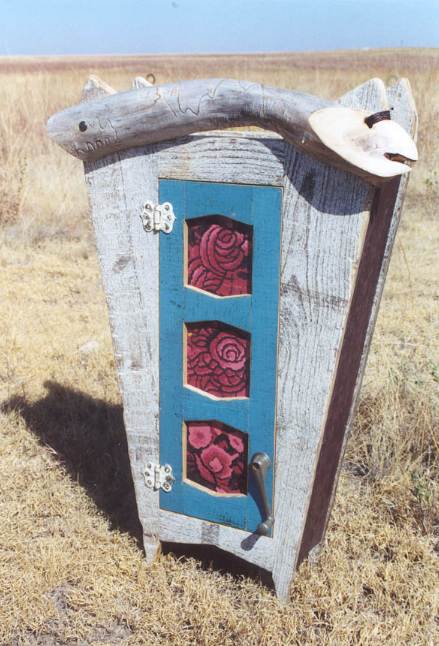
At first the roof tin on the corral shed just looked beat up, recycled from other buildings perhaps. But then the realization hits that those are hail dents all over the roof. It is easy to imagine the racket the big hail made on the tin, the terror of the animals, the empty feeling of the ranch family as they viewed the remains of the garden and a hay crop. Strips of that dented Tennessee V-drain roof tin now clad the Sky Ice Mirror frame.
Door trim from the Luther Hill country school borders the tin. Corner brackets once braced gangs of grain sieves that clattered over the pan in a Case threshing machine.

The odd assembled pieces and parts: a pair of skates, doorknobs, table remains, bottle stoppers, do not appear too promising. But each piece has a story and is part of the larger story of BJ’s family. She sends me home with this assortment and the charge to see what I can put together. I decide not to take the carpenter’s level standing in the corner by the door. I cannot picture how it could work into a future piece of furniture, or bear the thought of cutting a level in two.
Eventually, all the family story parts are spread out in the studio and the oak table remains become the takeoff point for the design. BJ’s Great-Uncle Alex made the table for his bride, Francis. After a year of marriage, Francis and Alex decided it just wasn’t working out, so rather than get a divorce, Alex bought the house next door and Francis moved in—table and all. They remained good friends, husband and wife, eating every meal at the table. They lived out their lives this way. The base of the old table becomes the top columns and corbels for the On The Level tall chest. And the tabletop provides enough material for second-life doors and drawer fronts.
In order to have the turquoise and white accent colors for the tall chest, as well as enough case lumber, reclaimed interior trim from the Hostutler homestead down the road from us in Lipscomb County, Texas is combined with Great-Uncle Alex’s table. The Hostutlers raised nine children in the small, but sturdy, house. My wife’s Aunt Mary tells the story from her childhood of how the Hostutlers, being Nazarenes, would gather with a small group of their brethren for evening services in the old Prairie View school house. Aunt Mary and Uncle Herman would sneak across the east field and peer through the school windows hoping to be entertained “by all sorts of holy-rollin’ and wild goin’s on.” If they saw Mrs. Hostutler kick off her shoes, then they knew the show was about to start.
As the case for On The Level comes together, I realize there is a remote chance that the left-behind level might work into the design. Still though, I am loath to cut the level up, and I am afraid it will be too long for the piece. I call BJ anyway and request that the level be sent.
In the meantime, other odd parts find a home on the chest. Bottle stoppers or caps line the top crown and provide pulls for the top drawer. BJ’s Grandfather Gadzichowski cut ice on the Milwaukee River in the winter for the Milwaukee Ice and Coal Company. He was given so much ice per day to deliver. If at the end of the day he had ice left, called “shrinkage,” he could sell it and make a profit. With that profit he would buy beer for himself and root beer for his children. The caps were collected in an old coffee can and stored in Grandfather Gadzichowski’s basement.
Ice skates that the same grandfather used to skate the Milwaukee River become door pulls. BJ’s Dad inherited the skates when he was a little boy, but he hated the skates because they were “old-fashioned” looking and didn’t work too well as a hockey skate. But the family was poor and it was all he had to skate on.
Porcelain doorknobs on the cabinet come from Grandfather Gadzichowski’s sun porch. His eldest daughter, Suzanne, contracted tuberculosis when she was young. They built the sun porch in hopes that by lying in the cold, sunny area, she’d be cured. Ironically, Aloysius, their eldest son, had a stroke and died in the sun porch when he was just 44. Suzanne recovered.
The stove plate joined with the white doorknob at the top of the cabinet came from an old stove in Grandfather Gadzichowski’s basement. An old stove in Great-Aunt Francis’s house provided the plate handles for the main drawer pulls.
The white plaster relief inside the cabinet, a gift to Gordon and BJ for their wedding in 1974, is from Jules Orlandini, one of the few creative plasterers in the U.S. The relief is from the ceiling of a Frank Lloyd Wright structure in Chicago.
The level arrives. It doesn’t seem long enough as I remove it from the mailing tube; I am expecting a four-foot level. I hold the level up to the nearly completed cabinet. The length of the level equals the width of the cabinet. Only forty-two inches, a mason’s level, it belonged to BJ’s Grandfather Schmitt. He was a mason and a carpenter who helped build St. Josefat’s Basilica in Milwaukee. BJ has no photograph of Grandfather Schmitt. She has only the level.
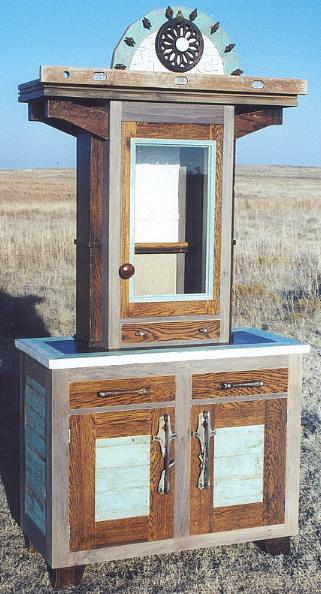
Over six feet tall, with a perpetual scowl and a wild shock of hair, Charlie Lynch had most of the kids in the small northern Panhandle town of Lipscomb convinced he was the bogeyman. Wide detours were taken around Charlie’s place. Most afternoons in the late 1940’s Charlie and his compadres would gather at Charlie’s for a card game of pitch. The game would usually go on until Charlie, becoming convinced that he was being taken advantage of, would jump up and declare he was “just going to have to shoot somebody.” Far as we know, he never did.
Car-siding boards from the back room of Charlie’s house now make up the door frames for the Wagon Sideboard. Red boards for the cupboard case are reclaimed from the old Raymond Akers barn south of Lipscomb. Roof tin from the barn serves as back panels. Raymond’s barn leaned so far over as a result of constant winds and too much hay in the loft that most folks were convinced the barn would fall on us as we carried out the salvage work. But, creaking and groaning, the wall stood right up to the last few nails. Old bed rails found inside the barn frame out a section of combine sheet metal for the top of the sideboard.
About 550 miles south of Lipscomb, down in the Hill Country, and out along Creek Road, the hardware remains of a small ranch wagon are pulled from a scrap pile. Axle spindles braced with tie-rods turn into legs for the Wagon Sideboard. And the front axle strap now braces the frame above the doors.

We have not yet posted the story on this piece…


