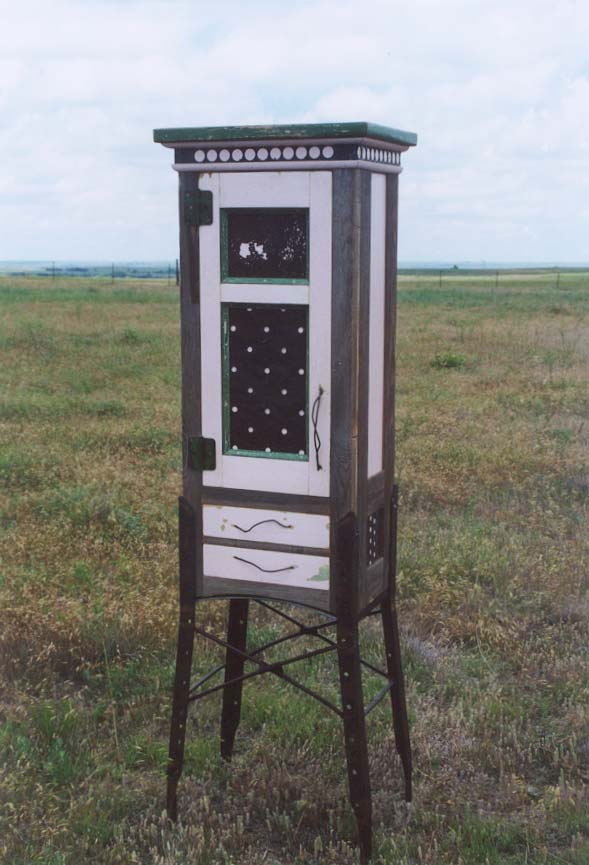
Scrap iron of every description lined the walls of the shed on the Lawrence Pundt Ranch north of Canadian, Texas. The purposeful jumble of pipe, rods, angles, and implement parts represented two generations worth of saving: first, Lawrence’s father, John, who built a house on the place in 1904, and then Lawrence until his death in November, 1999. Back in a dark corner of the shed stood two vane stems, or arms, from Challenge 27 windmills. Only one had some minor damage. Both were for 8’ diameter mills.
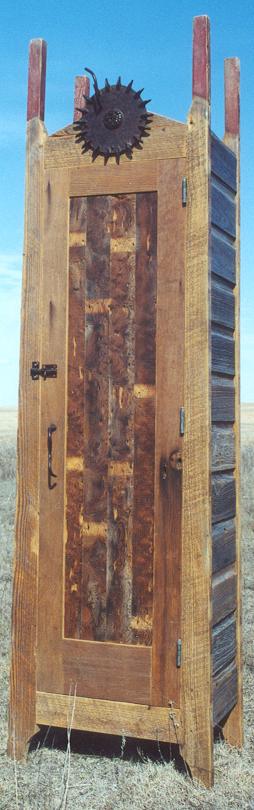
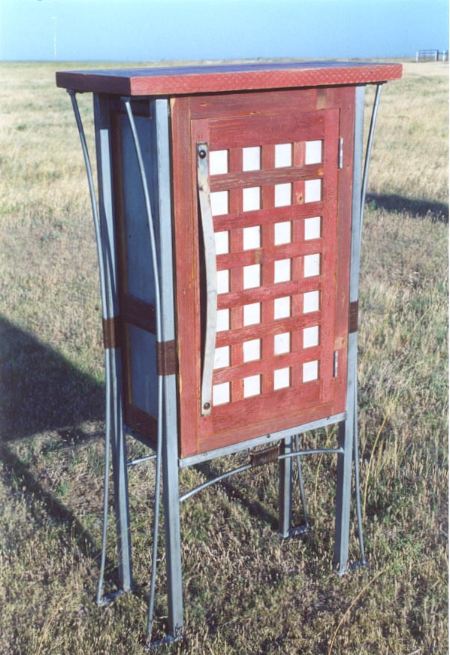
The pair of stems provides the design inspiration for the challenge Tower Chest. Shortened and braced with Dempster windmill wheel struts, the stems support and frame the case. The red door and side panels are salvaged from a closet door out of the Parker Boarding House in Lipscomb, Texas. The castoff door had been used as a worktable and a painting platform. White paint had built up so thickly on the back of the door that the wood had to be re-sawn before it could be used.
The “headhouse” cabinet is housed in a gear bonnet from a 6’ diameter Dempster windmill. Brass spools out of well checks are used for door pulls. Door panels are the last remaining sections of a cut-apart implement gas tank. The tank with its wild colors and rust stains comes from a wild place. I risk having someone come after me if I tell more of the tale about how I came by the tank.

I have to smile when I think of the various parts of the Longleaf Low Table coming together for a second go-around. Every component barely made it. Barely survived getting thrown in the fire, or hauled to the dump, or thrown in the scrap pile. The turned posts at one end of the table were part of a widow’s walk on an old Victorian home that had fallen to the wrecking ball to make room for a freeway expansion in Austin, Texas. The oil well sucker rods on the opposite end of the table are leftovers from a corral upgrade.
Saved from the fire, the white frame boards are former fence boards from the Parker House in Lipscomb, Texas. Before finally finding their way to me, they were stacked in a barn where they were attacked by termites. Center panels are made from longleaf pine 1×4 skip sheeting. When the sheeting lumber comes off the barn roof, bristling with nails large and small, and caked in Dust Bowl dirt, it is very tempting to haul the whole lot to the burn pit. And the white panel on the little door comes from the front door of a long-abandoned homestead on Willow Creek.

Grandpa Bucher died 50 years ago. The tools are long gone and only parts of the forge remain. Termites and time have worked the old barn over. Hardest hit by the elements and insect damage, the wagon drive-through is the first part of the barn to be salvaged. Reclaimed rafters, red tails now pointing skyward, frame the Over the Forge Tall Chest. Tongue and groove boards from the granary wall now side the chest. Sections of the skip sheeting boards that once ran perpendicular on top of the rafters as nailers for shingles–and more recent corrugated tin–have been joined for the door panel. Still showing evidence of the years of forge work, the boards with the smoky patina and blond rafter marks are curly longleaf or longstraw southern heart pine. Logged heavily until the ‘30’s, the old growth longleaf pines are almost extinct now.
With 100 or more nails per board and pounds of fine grit, salvaging the sheeting is a numbing task. A task made worthwhile in the end by giving the old barn a second life and conveying some of the life of a hardworking little man with a big hat who cared for his place south of Wolf Creek in Lipscomb County, Texas.
The Tall Chest is capped out with a feeder wheel from a planter can. Nails from the tin ridge-row fill the center of the wheel. And the top of a pin from a horse drawn dump rake has become the door pull.
Along the outside wall of the old wagon drive-through in Grandpa Bucher’s barn, opposite the granaries, Grandpa had enough room for a narrow workbench, some tools, and his forge.
The old homestead in the north central Texas Panhandle has a sad air about it. Every part of the place has been used up and worn out. Wind moans through the broken windows of the old house and old farm machinery and abandoned cars are lined up amid the weeds. Two brothers, each distrusting the other, lay claim to the place. There were times during the salvage that I feared I would be shot or jailed, or one brother would shoot the other.
Thankfully, I made it home with blue-green bedroom doors and red kitchen trim. And I haven’t heard of any shootings that direction.
Freed of the sad house and layers of dust and soot, the reclaimed wood gets a second chance as casing and doors on the Ties That Bind Sideboard. Legs and top frame are cut from oak corral boards that outlasted pens of cattle over the years and finally, the posts the boards were spiked to. Roof tin from a burned chicken house is used for the top panels. The red door panels are overlaid with security fencing made by the Fort Worth Fence Company. Rescued from a scrap pile, the bottom hook is more than likely part of a horse drawn implement. Door and drawer pulls are wagon tailgate wingnuts.

The little homestead northwest of Mobeetie, Texas had been quite a place in earlier years. Cement sidewalks border the house and lightning rods guard the roof ridge. But no one has lived in the house since the 50’s and a grass fire of a few years ago burned most of the trees on the north side of the place. The view to the south takes in a remnant of the old Dodge Freight Trail from Dodge City, Kansas to Fort Elliott in Mobeetie, and the Sweetwater Creek valley.
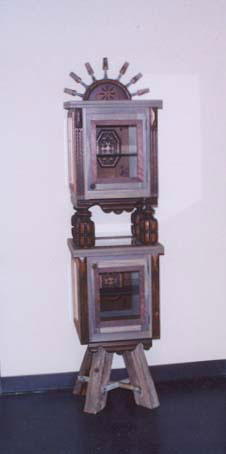
Reclaimed interior trim from the house has become the case for the Sweetwater Overlook. During the salvage process we discovered neatly folded pages from a 1929 Sears and Roebuck catalogue stuffed in behind the door and window casings, an effort to cut down on drafts and dust. Parts of the kitchen and front doors have been used for the cabinet door. A linoleum scrap from the lean-to room off the kitchen has found its way to the center point at the bottom of the cabinet.
Crowning out the Sweetwater Overlook is a row of combine sickle-bar teeth superimposed over a layer of mica. Sharp and spare like the land above the Sweetwater, but with an underlying beauty.

Northwest of Mobeetie, Texas, the old McLean place has seen its share of boom and bust, ebb and flow on the High Plains. Part of the Running Fight Battle during the Red River War of 1874 occurred on the land. After the Comanche and Kiowas were subdued and the hide trade lumbered to its rapid zenith and extinction, the Dodge Trail cut through the McLean country on the way from Dodge City, Kansas to Fort Elliott in Mobeetie and on to Fort Griffin further south.
The McLeans settled the place around 1898, first living in a half dugout in the breaks above Sweetwater Creek, then in a stout frame house they built up on the flats. They made it through the 30’s, but the drought of the late 50’s may have been too much to last out. The little white stucco house has been vacant since then. Now a rancher on his feed route or an oil field service truck in the distance is the only activity around the place. The gash of the Dodge Trail, still about knee-deep, runs a few yards south of the house.
Stepping over the crumbling threshold, I am greeted by some lace and an old cowboy boot, the sole worn completely through. In the pink room, an envelope from December, 1941 lies on the floor under a table. Someone in later years has written “The Man Who Died” above the address.
Sears and Roebuck catalog pages from 1929 fall to the floor as trim boards are pried loose. Patches of pressboard with layers of pink and blue paint are salvaged from the kitchen. The green screen door has been protected by the porch and still seems solid. The disassembled parts of a child’s swing set are discovered stacked under the debris of the fallen porch ceiling.
These castoff pieces have come together for the Dodge Trail Reliquary. Swing set legs, with deep furrow drill points for feet, are braced by oilfield scrap. Valve handles have become door and drawer pulls. Parts from the pink room and the screen door frame the reliquary case for the letter, boot, and lace at rest behind the old refrigerator shelf.

For twenty years or more, no matter what job I was on–house, barn, or remodel—the saw boards went with me. Every saw kerf on the boards was put there by me. But my present days as a furniture maker have put an end to my travels as a gypsy carpenter, so the saw boards have stood gathering dust at the back of the shop.
Fascinated by their surface texture and too attached to the saw boards to use them for firewood, I decided to pair them with lumber from the old barn of my wife’s granddad. With nail after nail holding the barn together against the wear of time and racking of Texas Panhandle winds, the barn lumber, like my saw boards, shows the effects of a lot of work and hard use.
Door and case panels are cut from a large blue and red plywood disc that has been kicked around the barn loft for years. The disc has been buried in hay, played with by various kids, and for some unknown reason, never thrown away. None of us that are still around can remember the original function of the disc. And I never realized how interesting the paint surface was until part of the barn roof was removed and more light penetrated the dark loft. Scrap cuttings from the outer edge of the disc frame out the interior story cabinet.

As a contract pumper in the Oil Patch, my late father-in-law Frank Bucher was always dragging in some useful item of scrap. Because he was colorblind (and the colors in the Oil Patch tend to the bright and just plain weird), we couldn’t wait until Frank declared what color the scrap appeared to him. His corner posts, corral gates, and patches on the barn were usually an assemblage of odd painted parts.
Our corral building, fence building, and calf working projects–in all sorts of dusty or hot or cold weather–would prompt Frank to declare that, “You’ve got to pick your days.” After a while, that came to be a family greeting of sorts. And still is.
So it is fitting that sections of blue square tubing chopped from a bent-up tank battery fence has been matched up with painted wood from an orange table leaf found in an abandoned farm house. The top frame for the You’ve Got To Pick Your Days Sofa Table is made of rafters from the barn of Frank’s dad, Anton Bucher. Skip sheeting boards once nailed across those rafters now make up the door and case of the side cabinet and drawer box. Tin top and side panels are fashioned from flattened 40-pound, tar tins that Frank nailed over the north side of Anton’s barn in the late 50’s.
Stan’s granddad strung the first phone wires in Stanton County, Nebraska. Granddad had a sideboard cabinet–now beyond the repair or fixing-up stage and in Stan’s possession. Maybe a trip south to Texas for the old cabinet and the chance for a second go-around.
In various states of “apart”, the family heirloom arrives in Texas to be sorted out and matched up with some gumwood discovered in a shed in Canadian, Texas and barn siding from Grandpa Bucher’s barn. A couple of phone pole crossarms and metal braces provided parts for the reliquary base. And REA insulator posts crown out the You’ve Got To Ask Reliquary.
The stucco house on the old McLean homestead north of Mobeetie, Texas has stood empty since the late 1950’s. The place overlooks the Sweetwater Creek valley with its Red River Wars battle sites, and the knee-deep gash of the Dodge Trail passes only a few yards south of the house. A rancher on his feed route is the only traveler passing by the silent house these days.
Just up the slope from the house in the remains of a shop–the victim of a prairie fire some twenty years ago–the John Deere, timed-space planter gear is found. To the north, a 1940’s-era Case tractor with its half-round, orange canopy sits akelter in the tall grass. The back door of the house is weathering to pieces. Inside, a scrap of lace lies next to a cracked and curled cowboy boot. When salvaging starts and trim is pried from plaster walls, folded scraps of crumbling paper fall to the floor—pages from the 1929 Ladies Home Journal that had been slipped behind door and window casings in an attempt to keep out dust and drafts.
Did the dust and drought of the ‘50’s, with the resulting low crop yields and cattle prices, finally force the folks off the McLean place? The house only reveals part of the story.
Capped with a section of an orange, 55-gallon antifreeze drum and standing on the main gear from a horse-drawn mowing machine, the Timed-Space Reliquary pays homage to the High Plains inhabitants who dealt with the dust, depended on work and the weather to make a crop, and made some lonesome spots into homes.
The section of green porch column comes from the Peg Robertson place a few miles north of the McLean land, just south of the Washita River. And Dick and Geri’s place north of the Washita provided the yellow, longleaf pine boards for the Reliquary case.
Green cabinet boards from Tom Conatser’s house on Boggy Creek north of the Canadian River are reworked for the frame and side panels. And the door is made from the parts of a basement door salvaged from a supposedly haunted house in Higgins, Texas. Piano ivories and striker parts from a castoff player piano now serve as “High Plains scrimshaw” to more permanently chronicle the tally marks found on area barns and granaries that recorded the bushels of grain loaded onto and off of wagons, a half-bushel bucket at a time.
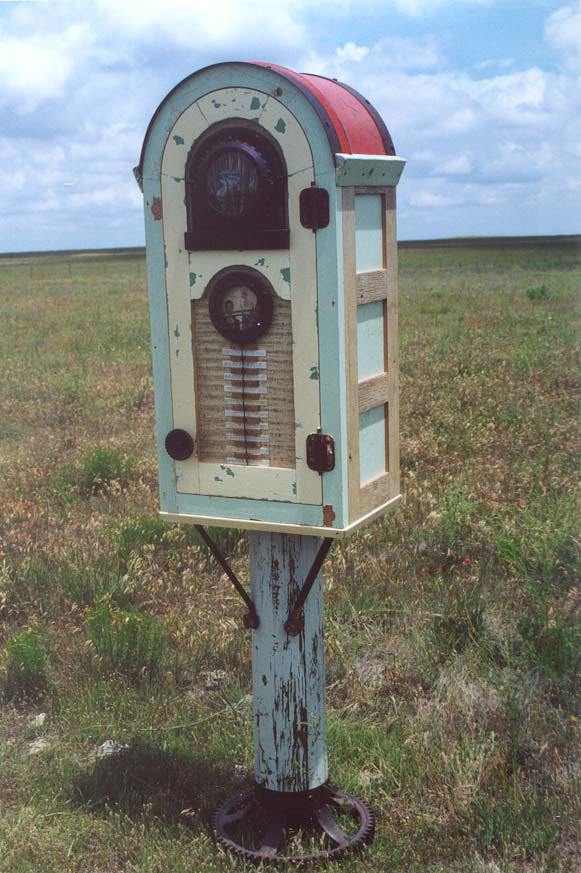
The barn owls grew increasingly nervous as the salvage work progressed on the Half Circle Ranch granary in Lipscomb County, Texas. The owl’s favorite perches of joists and wall plates were still solid, and draw-bolts joined ledger boards to blocking on the exterior siding. But the foundation plates and lower wall had been reduced to paper husks by the termites.
Nine miles east of the Half Circle, the twin granaries of the Bucher barn have held their share of seed wheat and milo, as evidenced by groupings of tally marks scattered on boards around the door openings. Rafters and studs from the Bucher barn are now held together with the Half Circle granary draw-lots to form the case for the Solstice Granary Chest. Red kitchen door panels from the Easley place in Hutchinson County are now the case’s side panels. The door frame is made from an oak corral board from the Shaller Ranch in Hemphill County.
On an afternoon junk run, good neighbor Lloyd asked his usual question as he showed me a pile of iron, “Your dump or mine?” The short length of combine elevator chain that crowns the Granary Chest came from Lloyd’s offering, as well as the old-style reinforcing bar now bound to the door panel with strands of baling wire saved from our days of Angus cattle and countless small square bales.

Lying on the edge of the caprock over the Palo Duro Creek valley in Hansford County, Texas, upside down with a shelled-out cavity to the sky, the hull of the old Case threshing machine had taken on a rich, rusty patina, courtesy of the Panhandle weather. If the light is right, ghostly groupings of numbers can be glimpsed on the thresher’s sheet iron, evidence of long-past, harvest days when threshing crews figured their bushels per acre.
A few miles southeast of the thresher’s resting place; out on the wheat-growing flats of Hutchinson County, the remains of the Easley place creak in the wind. Inside the old house amid the ruins of the years, brightly painted woodwork tries to shine through: red for the kitchen cabinets, turquoise in the front rooms, and white in a bedroom. Outside though, the house is weathered to a dusty silver and the persistent Panhandle winds are peeling the siding away. The story goes that four times over the years Mrs. Easley purchased paint for Amrine Easley to paint the outside of the house and he never got around to doing it.
As the last of the salvage boards from the Easley homestead are being sorted and sawed for the doors and case of the Thresher Moon Chest, and as the threshing machine sheet iron becomes door and side panels, I notice an obituary in the paper. Amrine Easley has passed away at age 92. His wife died in 1990. They moved to Dalhart in 1949, so the weathered-down house–except for short stays during plowing and harvest–has stood empty since then. More of the story comes together.
Handles for the chest are part of the pounds-per-acre calibrator on a seed drill. Sections of barn sliding door track serve as legs for the chest. And tin flashing that had deflected rain above the door track crowns out the Thresher Moon Chest.
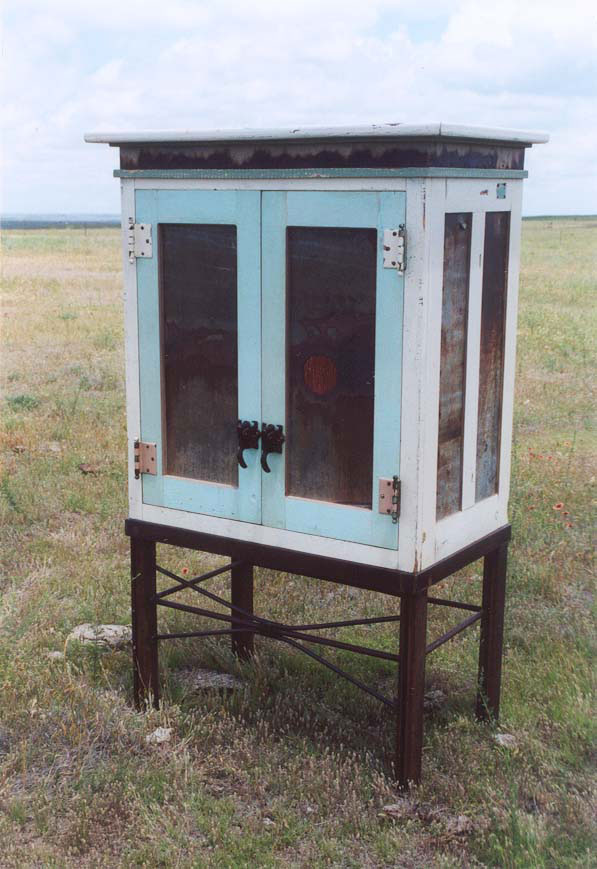
With pounds of old spark plugs and truck valves in the oven, and bolts, mud dauber nests, and tractor parts in the burner cavities, the old cook stove is almost passed over for the last salvage run. Further doubts are raised about the worthiness of the old shell during the physically taxing chore of lugging it from the back of the decrepit shop, over all the intervening junk, and onto the waiting trailer. After a wild ride and scouring in a Panhandle thunderstorm, the brightened old stove reveals itself to be a 1926 New Perfection.
Rusty, perforated parts from the stove’s oven are joined with pink and green trim from a haunted house in Higgins, Texas and gray siding boards from the wagon driveway in the Bucher barn near Lipscomb to make the New Perfection Story Chest. If there are spirits in the old house, they leave us alone during the salvage work. We did find a small, half-full bottle of bay rum hidden behind the basement doorjamb. Newspapers under the linoleum in the bathroom date from 1938. Maybe the house escaped the April 9, 1947 tornado, or maybe it is one of the houses moved in from the country after the storm.
Wire door and drawer pulls are part of the strands of heavy gauge wire that spanned from wall to wall in the granary just of the Bucher wagon drive-through, and helped hold in the bulging weight of bushels of grain.
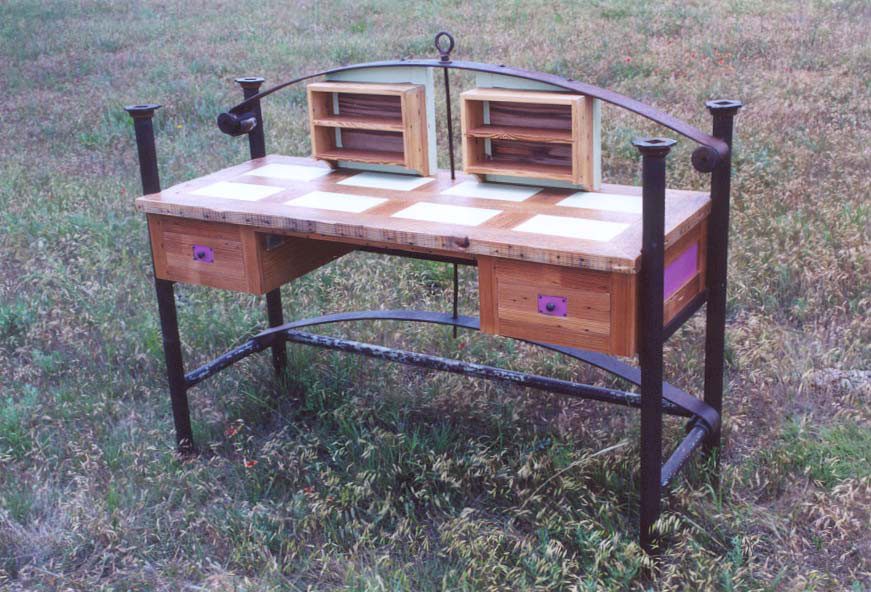
The rafter boards and skip sheeting 1×4’s from the loft of Anton Bucher’s old barn, and the last of the green cabinet doors from Tom Conatser’s kitchen needed to be paired with some purple painted metal. Now, the only way to get good purple is to find a Mystik oil drum. Noma at Sprague Oil in Shattuck, Oklahoma says, “You bet, we’ve got one.”
I tell Debby to make the Shattuck run to pick up the purple barrel. She returns later with the gleaming barrel and a truckload of truck parts and Sprague Oil scrap gleanings. She and Jack have decided to fix me up with some potentially amazing, but heavy junk. Before we sort through the whole pile, the pair of truck springs suggests the shape of the desk. A complete set (4) of barrel plugs might work to cap out the legs. Oil field gas line can go with the springs to complete the desk frame.
Rafter boards become the desktop. The skip sheeting boards, minus the almost 100 nails per board and pounds of fine top-of-the-barn dirt, are run through the planer revealing heart grain, longleaf pine.
Here is the the back side of the Mystik Writing Desk.
Up a slope east of Plum Creek in Lipscomb County, Texas, not far from the creek’s juncture with the larger Wolf Creek, the concrete and rock foundation of an old homestead is hard to see in the tall grass. Not far off, the strange, bulbous form of a concrete cellar rises up like a ruin from a lost civilization. Home to a rat or two, the cellar is in surprisingly good shape. Blow sand and grass have covered almost everything else. A Model-T dashboard and side panel jut out of the dirt. The only wooden leavings left are the parts of the windmill tower. The solid sections of two of the tower legs are now legs for the Plum Creek Serving Table. Salvage glass blocks from Glazier are held by the tower legs.
The top frame and the drawer box are made from a single oak corral board. Top panels and the drawer front are joined-together shutter slats from salvage plantation shutters that good friend, Maurice Bernson, had happened on. Like the patched and wired-up windmill tower, the drawer box is fastened to the welded frame with baling wire.

Over thirty years ago my late father-in-law Frank Bucher made a plywood water ski board (or sled) for towing groups of kids around area lakes on weekend family excursions. Since Frank was color blind, there’s no telling what color he thought he was painting the board. By the time I came on the family scene, they had moved on to newer and faster, but equally dangerous, ski contraptions. During every water skiing outing, usually when the dirt was blowing, the flies were biting, and it was so hot that the lake had turned over–without fail, Frank would announce, “It doesn’t get any better than this!”
Over the years the red plywood sled got shifted from one storage place to the next, finally being pressed into service as a threshold gate to keep piles of milo from spilling out the granary door in the old barn. Year by year more red paint peeled off to reveal the coat of green.
No longer do we keep grain in the granaries and the time has come to salvage the old barn. It seems only fitting to pair the old ski board with 2x’s from the granaries. Even though the grain weevils have worked the boards over, re-sawing reveals that the lumber is sound.
Door pulls are cut from sliding door track. The Wine Cabinet frame is welded from scrap tubing salvaged from a backed-into oil field meterhouse fence. Gas pipe is bound to the square tubing with baling wire. And the cabinet case is clad in burned-down chicken house roof tin.

During the year 1908, while the Hostutler family lived in their barn, they built a wood frame house. Just west of Willow Creek in Lipscomb County, Texas the small house is built with quality grade lumber—southern longleaf throughout. A porch with redwood turned posts wraps around two sides of the house.
In later years with an expanding family, the Hostutlers enclosed and screened the west stretch of porch for a sleeping room. Still later when indoor plumbing came along, a small bathroom was added at the end of the porch.
Long vacant by the time salvaging starts, the porch is well on its way to weathering down. No pry bar is needed to remove the first short piece of car siding from the enclosed porch section. I have to step back. An almost spectral sight greets me. Like a long-hidden bone, the corner porch post shines behind the gray skin of siding. Some competent past carpenter has even scribed a board to fit the post beading to limit the mouse runs in the wall.
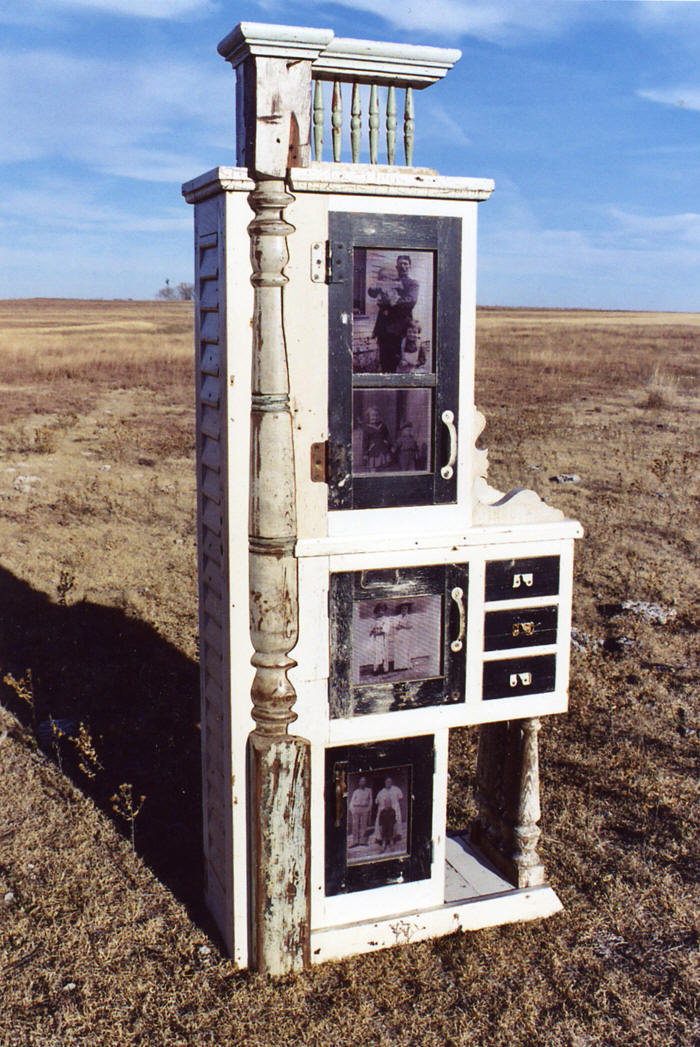
The memory of the hidden post stays with me. I wonder how to do justice to the porch secret. An old black screen door finally brings it all together. The screen door hung on Grandma Bucher’s back porch. When we tore the old house down in 1978, we recycled part of the wood into a new chicken house. The screen door became the door between the brooder and laying rooms. Twenty-two years later we no longer have chickens, so the chicken house is the tool shed and the black screen door isn’t about to head to the dump. The Good Bones Porch Meditation is on its way. Crown molding and some crackled interior trim from the Hostutler house joins with interior trim from a homestead north of Mobeetie and another house east of Sunray. Short turned posts from a demolished house down in Austin are now at home with eave brackets from an Ellis County, Oklahoma house and green spindles from the porch screen on Tom Conatser’s house north of the Canadian River.
Family and friends in front of their respective porches and houses grace the door panels of the Good Bones Porch Meditation.
Too difficult to tear down and rendered obsolete by their larger concrete offspring, wooden grain elevators of the plains stand in silent memorial to past harvest days. Like no other event in the yearly agriculture cycle, harvest concentrated everyone’s energy, anticipation, and dread into a two-to-three week blur of activity. How the rest of the year played out and how mortgages paid out came down to this whirl of heat, wheat dust, and trips to the elevators.
Neighbors and friends, Anton Bucher (my wife’s grandfather) and Ivon Case of Lipscomb County, Texas, shared a lot of their farming and harvest chores. Photos on the Harvest Meditation show Grandpa and Grandma Bucher and offspring along with neighbors standing in front of a team. Ivon Case runs the binder and brother Jim Case works the header barge and stands astride the Rumley steam tractor. A threshing crew with their J.I. Case threshing machine and supply wagon arrives on the Case farm. And Ivon, along with family and neighbors, chops ensilage for a silo on the Lemaster place north of Lipscomb.
Flattened tar tins that covered the weathered, north wall of Grandpa Bucher’s barn now clad the Harvest Meditation. Parts of the barn’s granary walls have become door frames and drawer fronts. Pulls are links of binder chain. Door panels are sections of reel-batts from the header of a John Deere 55 combine, the surface sculpted from acres of grain and straw. Blue and white trim boards are cut from door and window casing salvaged from an abandoned homestead that sits a few yards from the still-visible ruts of the old Dodge Trail just north of Mobeetie, Texas.
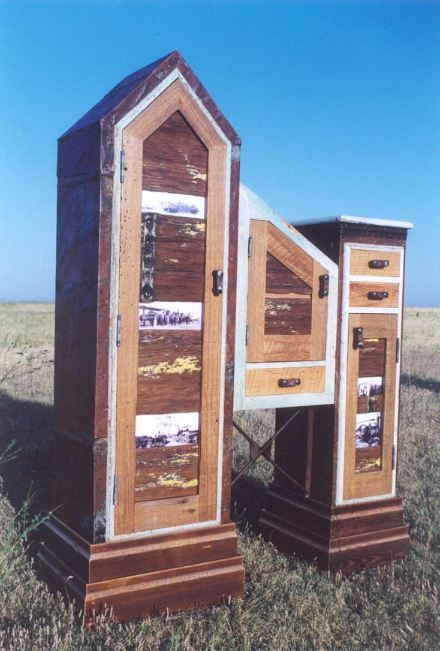
The only remaining red paint on Grandpa Bucher’s old barn could be found on the eave and rake boards, and some of the siding boards high on the gable ends. The short eaves had given the lumber some extra protection from the hard Panhandle weather. Parts of those red boards form the case of the Loft Door Cabinet.
On a cold February day salvaging began on the south gable end of the barn. Winter salvaging on a barn roof makes for some spectacular views of the surrounding country and the extra clothing provides added padding when sitting astraddle the ridge. The disadvantages are nearly frozen extremities and all the extra, bulky clothing. But, as the recycling continued down the gable to the old loft door, the sight of the dried and curled harness leather hinge–and the worn arch where the hasp had swung back and forth for years–brought visions of all the early morning trips Grandpa Bucher made through that door.
Door and side panels are cut from a sheet of Tennessee V-drain roof tin. Baling wire binds the welded frame.
Three generations stored hay, lumber, and equipment in the loft of the old barn. Down below, the floor joists supported the weight with the help of a granary wall and a lone porch post. When the bones of the barn saw the light of day during the salvage process, the result of all the years of heavy loads could be seen in the joists. All had a downward sag and an alarming number had serious splits and cracks. Sections cut from those long-suffering joists now make up the framework for the Storyteller’s Chest. Purlin boards from a granary barn on the Half Circle Ranch have become side frames. Elevator chain from a Gleaner-Baldwin combine braces the front frame.
A blue door from Room #7 in the old Hotel Higgins in Higgins, Texas gave up enough usable parts for the doors and side panels on the chest. The items framed in the doors are gleaned from several years of “looking through the ruins.”
The inside back panels are the last linoleum remnants from an upstairs room in an old homestead on Willow Creek near Lipscomb, Texas. On my first exploratory trip into the dark room, I startled a bobcat that had been sleeping in the attic just above my head. Amid flying ceiling boards and pounds of dirt, he went out a hole in the roof and I somehow made it down the rotten stairway in two bounds.

My neighbor to the northwest, Clarence Case, said he had something to give me if I could ever get social enough to come over and pay him and Elma Lue a visit. So on a hazy-hot August morning, Clarence and I stood out in his barn by the corral. Pointing up into the dust and accumulation in the rafters, he said, “See those two porch posts? They are the only things I salvaged from our house that blew away in the tornado. I’ve kept them all these years and never used them for anything. They’re yours if you can use them. And there’s a bunch of old trim and lumber from the folks’ house when we remodeled in ’61. Take that, too–if it’s any good still.”
“The tornado” that Clarence referred to was the storm of April 9, 1947, that slashed across the Texas Panhandle and on into western Oklahoma. Clarence’s family survived the storm, but a lot of his neighbors did not. The tornado remains a defining event for a lot of families and several area communities.
One of the porch posts, split in half, is combined with the leftovers from the remodel for the Up From The Ruins cabinet. Clarence related that his folks’ house had once belonged to one of the area’s most notorious bootleggers. A trap door that once opened on a secret stash underneath the bed in the front bedroom is now covered by carpet. And there are holes in a closet wall where copper pipes ran from a still to the stove in the kitchen.
Clarence and other old-timers often tell a story about my wife’s grandfather, Anton Bucher. Back during prohibition Anton was called for jury duty in the trial of a man accused of bootlegging. Each prospective juror was called to the front of the courtroom during selection. When Anton’s turn came, the prosecuting attorney asked “Mister Bucher, would you take a drink of whiskey?” To which Anton answered in his heavy German accent, “Yah, if ya got some.” It took a while to restore order. Anton did not serve on the jury.

“Your dump or mine,” Lloyd Fry asks as he retrieves his latest junk discovery from the back of his truck. “Thought you might not have a chick feeder.”
I do have one, I tell Lloyd, but his has obviously suffered more than ours and has greater furniture possibilities. And sure enough, the chick feeder escapes the dump and becomes the center door crest on the Chickvane cabinet. The door frame is made from some of the still-red boards salvaged from Grandpa Anton’s barn.
Front legs on the cabinet are Aermotor windmill vane stem parts. The third leg is a lifter arm from an old binder.

“Even bear grass looked good to us in the ‘30’s,” said my dad, Glenn Ricketts, as he helped me clear clumps of the tenacious yucca from our north pasture. “How so?” I asked. “Cattle will eat it if they are hungry enough, and during the Dust Bowl, sometimes bear grass was the only thing growing,” he explained.
Coming of age in the 1930’s on a farm in the Progressive Community north of Hereford, Texas, my dad, in order to help get enough feed for the cattle, would fill a wagon with grubbed-out bear grass plants. Returning to the corral, he would chop off the spines and then chop up the blades into small pieces. When he had a washtub full he would spread the bear grass out in troughs for the cows. It was quite a sight to see a whole line of cows with suds foaming out of their mouths as they went after the bear grass or “soap weed.”
Serving as a good illustration of the dogged determination and desperate inventiveness of Panhandle folks during the depression, the story of the bear grass cattle feed inspired the Bear Grass Requiem. In the center door section, ribbon or “saber-point” barbed wire (pat. 1881), first used in the Panhandle to fence railroad right-of-ways, is woven with bear grass blades. The red panel and blue-green trim came from a Hutchinson County farmstead, last inhabited in 1949.
Leila Litchfield, the maternal grandmother of my wife, Cathy Ricketts, pieced the top quilt section. She may have had help with the quilting from the Busy Bee Club of Higgins. In all probability the quilt was made after 1947, because Leila lost all of her family possessions in the April 9th tornado.
The bottom quilt section comes from a quilt made around 1900 by Jimmy Leona Horne (b. 1862), Cathy’s paternal great-grandmother, and brought to the Panhandle in 1915 by her grandmother, Ida Bucher, when she married Anton Bucher.
(Note: these quilts were damaged and sectioned up for other projects long before I had the privilege of using the small portions.)
Salvage parts from the old Hostutler homestead on Willow Creek in Lipscomb County make up the rest of the Requiem cabinet. The case is made from old doorjambs. A closet door, sawn apart and reworked, is now the Requiem door. And old exterior siding, covered for years by stucco, now sides the cabinet.
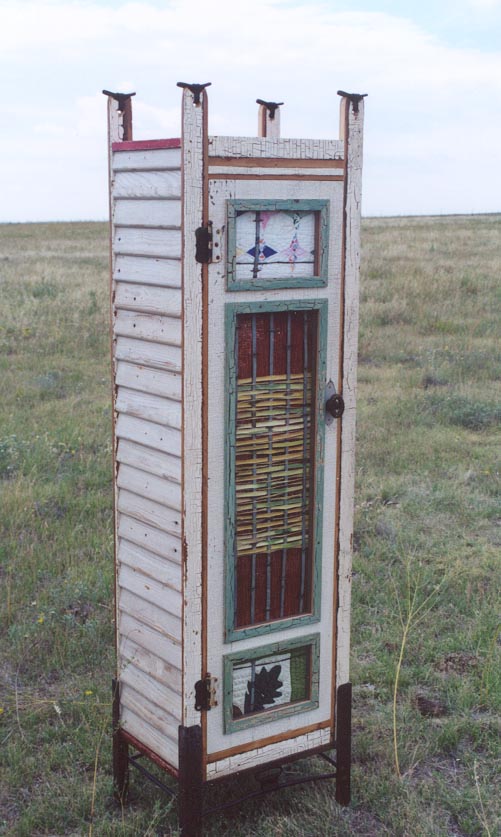
“There was no reason for the red corral gate to be hung so near the ground. We raised cattle, not rabbits, and every winter when the blizzards would blow through, the gate would drift shut, usually with half a dozen cows on one side looking longingly at the water tank on the opposite side. Then a mountain of snow would have to be moved in order to swing the gate. Finally, after one particularly bad blow, the cutting torch was hauled out and the bottom rail was consigned to the scrap pile. Too light for corral or fence repair, the rail got shuffled from one pile to the next for several years until it was paired up with sections of a hammermill screen to form the legs for the Reliquary table.
Parts of plantation shutter louvers and frames clad the cabinet portion of the table. An ebonized, oak corral board yielded enough material for the top frame.

Before we planted our terraced fields to grass, I made many a round on a John Deere tractor, first with an old reliable 830 and later with a cab-and-the-works 4250. My Pollyanna list of farming was short: first of all it is a great way to watch hawks going after their supper, and secondly there is all sorts of time to come up with furniture designs. And the design gets worked out in your head; no way to do any drawing, and all day of round after round to figure it out.
The farming days are over and the green machinery has moved on, but leftover parts, some with a good showing of green paint can still be discovered in buckets and bins on the place. A few of these parts have been resurrected as hardware for the John Deere Dreams cabinet. The door panels are cut from a pair of barrel lids, once used as props for some spray painting.
Salvaged pieces of interior doors out of the Hostutler house down the road from us on Willow Creek now make up the door frames, drawer fronts and top panel on the cabinet. The Hostutlers built the little house in 1908, and eventually raised nine children there. No one has lived on the place for forty years.
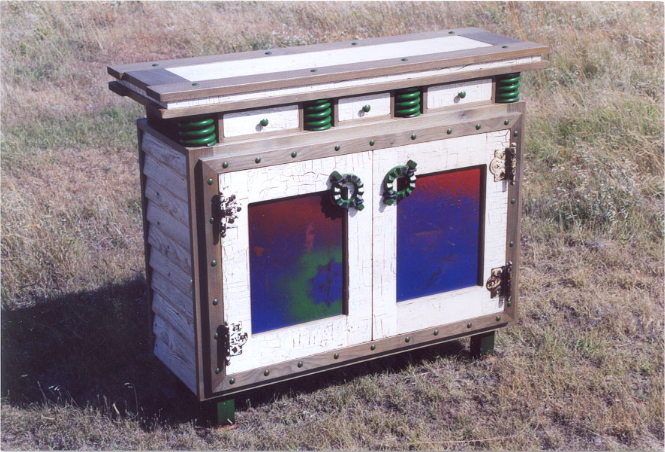
Standing at the edge of the west field, the long dead cottonwood, towering trunk and stark branches reaching skyward, glowed with a mesmerizing luminosity on moonlit nights. Recent high winds finally brought it down. Now, more spectral and sad, the giant tree still glows in the moonlight. A small lathe-turned portion of one of those stark gray-white branches graces the Moon Dreams wall cabinet.
Parts of an old homestead entry door with the ghostly image of the long-gone backplate become door and drawer panels on the cabinet. The last scraps from a purple Mystik oil drum lid shine through the gaps.

The oddest chunk of wood to turn up at my studio had to be the rosebush stump delivered by a second cousin from Albuquerque. She thought of me when she dug up the dead bush and she just knew I could do something with the fierce-looking remains.
Once the stump–thorns, limbs, and all–was mounted on the lathe, I had trouble sharing my cousin’s confidence in my abilities. But after some nerve-shattering, bark-shingling time on the lathe, a rare and extremely hard wood emerged. The rosebush wood is now showcased on the Last Rose Jewelry Cabinet, along with linoleum scraps from the 30’s and barn tin with “frosty” galvanized patterns. The drawer front and side panels are some of the last salvage parts from the homestead of the peddler and rounder, one-legged Peg Robertson.

The plywood contraption with the turned-up front had been stored in the barn for years. The plywood sported odd-shaped cutouts where sections had been robbed for other projects. Legend in my wife’s family had it that the red, once-green ply sheet had been a water-ski sled. I am just proud I came on the family scene after the ski board was retired—or banned.
The last remaining scraps of the red and green board are now combined with loft floor joists from the old barn–where it was stored for so long—to make up the top of the Corner Post Hall Table. The post table leg is a section of a corner post from a sagging stretch of the old dividing fence that ran through our place. When the new steel posts went in, I saved the unusual post from the firewood pile. A baling wire-wrapped windmill polish rod joins the post to a red frame made from sections of the top rail and swing arms of a child’s swing set. The stacked swing parts were discovered under the rubble of a collapsed homestead porch.


