January 6, 1918, the world is at war. David Wright, 25-year-old Texas rancher, fresh from basic training at Fort Sam Houston, finds himself rattling across the United States on a troop transport train bound for the boat that will take him on to France. In a letter to his girl back home, May Moore, Davy writes, “I am on my road to France, I think…this train is shaking so I can’t hardly write.” Toward the letter’s end he declares “May, I don’t dread going across so bad…somebody has got to. So I will do my bit.”
As the war progresses, May and Davy write back and forth. On March 14, 1918, Davy writes, “Somewhere in France. General Pershing to visit our camp tomorrow…sure getting anxious to hear from my little snookums…What do the people over there think about the war and how long do they think it will last? It looks to me like we are going to have a year and a half more of it.” On the 19th of March, he writes, “May, I don’t want you to worry about me…I think I am a long ways from being shot.”
In an October 11, 1918 letter–exactly a month before the Armistice–Davy tells May, “The Germans have been dropping bombs back here from airplanes…We are giving the Germans all they want…it has been one continuous roar of caissons, and sometimes this old house shakes like as if it is going to fall…This is the d—est country I ever saw, nothing but rain and mud all the time.”
May writes on November 28, 1918, “Today is Thanksgiving and we are all alone. The ground is covered in snow…I sure hope you will be here next Thanksgiving.” May’s stepfather, Charlie Lynch, has been drafted and is in France also. May and her mother Hattie work to keep their place together. From the same letter, May declares, “I’m a regular farmerette now, Davy, but I’d rather stay in the house this kind of weather.”
The winter of ‘18-‘19 is a rough one. May again, January 5, 1919, “We are still snowbound. It’s hard on the cattle…the trains have been blocked…mail comes over from Higgins [Texas]…twice a week in a wagon.” And by January 22, 1919, “Roads are awful. The car went down to the hubs out by the barn. Will take the horse…to town.”
Davy, deemed essential personnel as a mechanic for a truck and transportation unit, is transferred to the occupation force. March 19, 1919, he writes, “…this waiting to go home is as bad as the war on a man’s nerves.” He tells May on March 23, “Your future hubby is a sergeant now…I get $51 a month.”
By the summer of 1919, May and Davy’s own international incident takes place. Davy’s aunt Annie has written Davy to inform him that a French father has sent a letter to the Mayor of Canadian, Texas, Davy’s hometown, inquiring as to Davy’s character and background. The mayor, not being fluent in French, has the letter translated. The whole town soon knows about the letter. Of course, the news makes the 28-mile jump north to May in no time.
May fires off a quickly written note on August 4, “If you have to stay much longer, you will marry a French girl sure enough…thought I’d write a few lines anyway and not let that girl have everything her way…I don’t like the idea of writing to a married man but I can’t help but think they are mistaken.”
Davy sends a five page, typewritten defense on August 10. “I am so blue I am pretty near sick. It is not on account of the terrible lies that are circulating back there…but…because you believe them awful lies. Now May…I told you all I did…was last summer at Tours I met a French girl that wanted to learn American and you told me to learn French so I could learn you. Well, we tried to learn each other the different languages for about two months and then I left there…we wrote for a while and I saw that…she was getting serious so I quit writing her a long time ago.”
May’s letter of August 18 makes no mention of the French girl. She instead talks about going fishing, and sends news about other local boys that have returned to civilian life. She does mention Davy’s new typewriting skills and tells him, “Seeing you can type your letters you can write oftener, so do.”
Davy makes it back home to May and his ranch country of the northeast Texas Panhandle by October, 1919–two years and one month since joining the U.S. Army.
Spotting the young Ode Price on the street in Canadian, Texas in 1930, Davy Wright told him that there was a job waiting for him at home anytime Ode needed work. That home was May and Davy Wrights’ Glazier, Texas ranch and it had provided the most stability Ode had known in his growing-up years. His mother died when he was ten years old. He lived for short periods of time in the homes of his older brothers and managed to stay in school until age fourteen, when his father came to town and announced that Ode was big enough to work and support his father. Ode had different ideas; he took off on his own.
By age sixteen, Ode began dayworking for Davy Wright. But Ode decided to check out the promise of better wages and adventure in oil boomtown Borger, Texas. After working there for a while it became apparent that the wages weren’t much better than cowboying, and the expenses greater, so it was back to Canadian where Davy told him to come on home. When he turned eighteen, Ode went to work for Davy full-time. It would turn out to be the job he kept for the rest of his life. Never having had children of their own, Davy and May wanted to adopt Ode; after all, they had practically raised him. Ode, however, would not hear of it. He was too old for that.
Davy Wright moved large numbers of cattle. At one time Davy owned and lease-operated a total of sixty sections and had a bull herd of 300 head. In order to keep up with the widely dispersed herds of cattle, from the sand hill pastures of the Wright ranch to the wheat pasture country of the northern Texas Panhandle, Ode spent a lot of days and nights on horseback. During the winters he carried newspapers that he could layer in his pant legs to ward off frostbite. And if he had to make a cattle trail his nighttime bed, he could cover up with newspaper, his saddle blanket, and sometimes the saddle.
Ode married Ruth Ballew Bradney in 1954. Daughter of a Nazarene preacher, Ruth, like Ode, was a natural storyteller. When the two of them, sitting around the dinner table, really got going on a storytelling session, those listening had a hard time catching their breath from laughing so hard. This was especially true after one of Ruth’s famous mealtime spreads. Their daughter, Arlene Price Walker, inherited this amazing storytelling talent. Through her, all those rollicking good tales are remembered and passed on.
Davy Wright died in 1952. Ode, in partnership with May, continued to manage the ranch. He and Ruth looked after May until her death in 1987. The next year, Ode died. Ruth is gone now too, but Arlene and Ronnie Walker keep the ranch up and running. And they keep the stories coming.
May Moore Wright and Leora Barton Turner were childhood friends, attending school together in Lipscomb, Texas. A photograph circa 1913 shows Leora and May teamed up with the Cessna sisters, Hazel and Grace. Leora, part of the extended Barton clan that settled in Lipscomb County after trailing cattle north, married Bill Turner in January, 1920. Born 1897 in Missouri, Bill came to the Texas Panhandle as a child with his family. The year before he and Leora married, Bill helped drive the last herd of cattle up the Tuttle Trail that ran from Boggy Creek, near Canadian, Texas north to Dodge City, Kansas.
After May settled her mother’s estate in early fall 1920, Bill and Leora Turner rented the Moore place. Their first child Beatrice (Appie) was born in the house November 15, 1920. Four more children: Mona, Margie, Kenzy, and Kay came along in following years. The Turners made several moves in the time between 1920 and 1940, but they returned to the Moore place each time. Even after Bill and Leora moved to Lipscomb to run a grocery store and gas station, Bill continued to keep livestock on the Moore section. Granddaughter LaVaun Kraft remembers that when the hogs would get out and come all the way to Lipscomb, the kids had to “drive those blasted huge hogs back on foot” the two-and-a-half miles to the Moore place.
Of all the letters and documents saved by May Moore Wright, only about four give any information about the life of her father, Able B. Moore. According to his tombstone, he was born in 1843. Pennsylvania was probably his home state based on May’s letters to cousins and an aunt, and A.B. Moore’s Civil War record. He served with the Pennsylvania Sixteenth Cavalry, mustered in as a sergeant when the regiment was organized in the fall of 1862 and mustered out at the end of fighting in August, 1865. The regimental history shows that the Sixteenth Cavalry had 105 men killed or mortally wounded, and 194 men died of disease and accidents.
A tattered and pencil-smudged daybook with date entries of 1876-77 indicates that A.B. may have settled near Owensboro, Kentucky for a time after the war. A freight waybill shows destinations of Washington Territory, Omaha, Laramie City, Ogdon, Sacramento City, San Francisco, and Portland. Labor records for the freighters working for A.B. alternate with pages of recipes for colic and liniment.
According to May, her parents met in Missouri where both were members of the Lonely Hearts Club. Hattie’s background is even more of a mystery than A.B.’s. She did have relatives in Columbia City, Indiana. A young widow with two toddlers, she elected to leave her son to be raised by a brother-in-law when she and A.B. married. Hattie and A.B. Moore homesteaded along Wolf Creek in the Texas Panhandle in 1887. It is unclear whether Hattie’s daughter Lura made the initial trip to Texas or if she remained in Missouri for a time before rejoining the family. May was born in 1897.
Cecelia Augusta Jones, mother of David Wright, was born in Monmouthshire, Wales, 1865. When Cecelia was four her father died, leaving her mother with eight children. In 1870, the family sailed for America, eventually settling on a farm near Topeka, Kansas. Losing their mother when Cecelia was fourteen, the Jones children stayed in Topeka until 1883, when Cecelia and her five brothers traveled by covered wagon to Mobeetie in the Texas Panhandle where they settled on Jones Creek. Oldest brother Jenkin stayed on their newly settled land while Cecelia, Tom, Dave, Joe, and John moved into town, where the boys sold meat to the soldiers of Fort Elliott and the few remaining bands of Indians.
Cecelia married John R. Wright in 1885. Born in London, England in 1854, John Wright came to the Panhandle around 1880, first working as headquarters cook and bookkeeper for the sprawling Bar CC Ranch. When he and Cecelia married, John was partners with Charlie Rath in the Rath and Wright Mercantile of Mobeetie and he also kept books for the H-Y Ranch and the J Buckle Ranch. The Wrights went into the cattle business in 1888 and settled on Corral Creek.
To take advantage of the railroad boom and attendant business opportunities, Cecelia and John moved in 1896 with their six children to Canadian, Texas. Their seventh child was born after the move. John purchased half interest in the J.F. Johnson Mercantile Company, as well as the Gerlach Brothers Mercantile. He created a lumber company by combining the two mercantile companies’ lumber divisions. He also became a partner in the Bussell and Wright livery stable. This business had 93 stalls and could accommodate 200 horses. But, after several months of ill health, in 1898 John passed away, leaving 33-year-old Cecelia with seven children.
Cecelia sold her husband’s businesses and invested in cattle, eventually filing on a section of land northwest of Canadian in a canyon along the Canadian River breaks. The family worked here during the summers, using a small one-room house for cooking and eating and two dugouts for bedrooms. Winters were spent in town so the children could attend school and church.
Cecelia was president of the Presbyterian Ladies’ Aid Society and a charter member of the Women’s Christian Temperance Union (WCTU), the group responsible for reversing the wet/dry balance in Canadian. The saying goes: Canadian started with 13 saloons and one church; after the WCTU cleaned up the town there were 13 churches and no saloons.
Cecelia Augusta Jones Wright died on May 22, 1928.

We have not yet posted the story of this piece…
We have not yet posted the story of this piece…
Only a slight dip or depression in the sand bank marks the site of the Moore family’s first Texas dwelling, a dugout on the north side of the Wolf Creek valley in the northeast corner of the Texas Panhandle. Birthplace of their daughter May (August 18, 1897), the dugout had to be abandoned when the waters of Wolf Creek filled the valley and flooded them out.
Relocating to the higher flat ground south of the creek, A.B. Moore built their square, stout, wood frame house. The few photos from her early years show a serious but happy May, usually astride her horse. Her half sister Lura came to live with the Moores during this time.
A.B. Moore, a Civil War veteran and 23 years older than his wife Hattie, died in January, 1911. Hattie and May, with the help of hired man Charlie Lynch, managed to keep their small ranching and farming operation going. Lura, who married in 1909, wrote May in 1912 about her family’s hard times in Oklahoma. “Ralph had to shoot our calf today. It had hydrophobia [rabies]. The rest of our stock may take it. We are sure in hard luck. Sometimes I don’t know what to do.”
For another income source, Hattie converted one of their outbuildings into a boarding house. Ranchers checking on holdings along Wolf Creek and cowboys line-riding for the larger ranches, or looking for work would stay over at the Moore boarding house. May seems to have caught the eye of some of the young cowboys. Bill, nicknamed “Slippery Jim,” wrote May from Channing, Texas on the west side of the Panhandle in 1913, “Started back to Lipscomb [Texas] and got as far as Amarillo and the foreman of the XIT nabbed me just as I got off the train and begged me to come up here as they needed men bad…the wagon will be out two months or maybe three….Gee! but it does get lonesome out here. I most go crazy at times…Say dear how long will it be until watermelons are ripe? Do you remember those moonlight rides after eggs and melons? I sure do.”
Also in 1913, Hattie Moore and Charlie Lynch married. Hattie, born in 1866, was 23 years older than Charlie.
By 1914, Bill, working for the railroad, pines for the cowboy life. From his letters it is apparent that he did not get a lot of encouragement from May’s direction, and he had resigned himself to moving on, “…so you still have some good dances out here, do you. Gee! Girlie it don’t look as if I’m going to get back for you to learn me to dance.”
In 1916, Davy Wright, ranching in partnership with his older brothers, began staying over at the boarding house while on cattle buying trips. Davy took a liking to May and the frequency of his trips increased.
When the U.S. entered World War I in 1917, May’s and Davy’s relationship had matured enough to withstand a two-year separation while Davy served in France. By 1919 some of their letters show a good-natured exchange of opinions about future marital duties. January 5, May wrote, “I was surprised that you didn’t want to dry dishes when you get home, but you’ll have to anyway…I don’t worry because you will be so glad to get back, you’ll just delight in helping me. I’ll like to help you so it wouldn’t be fair if you didn’t help me.”
Later that same month, Davy wrote, “May, you say you don’t intend to cook after I get back but ride horseback all the time. Well that is a pretty good idea but my idea was to have a good cook and also a good cowpuncher—don’t you think that would be better or would you rather for me to get a French Mademoiselle to do our cooking, and when you was gone on a visit I would not have to batch. Ha, Ha.”
Davy came home in October, 1919. Wedding plans were set for June, 1920. May’s mother Hattie never got to see her daughter married. She passed away in May, 1920. The only record of her passing and the difficulties May faced during this time is found in a letter from Hattie’s sister Henrietta in Columbia City, Indiana. She wrote, “…in the condition she was everything depended on you…don’t see why you took your mother to Canadian [Texas]. There is no hospital at Lipscomb is there?” In October, 1920 May had an estate auction, selling the old farm machinery, Hattie’s model T, and the livestock.
May and Davy set up housekeeping on the Wright Brothers’ ranch in western Lipscomb County. Their house was in the Valley Park area where Gibson Creek flows into Wolf Creek. Neighbors helped each other work calves and drive the herds to shipping points or distant pastures. May had good friends close by and she was surrounded by her beloved Wolf Creek valley.
Davy had been looking for his own land, preferably closer to railroad stockyards. He purchased land a few miles northeast of Glazier, Texas in 1928, and soon after had a house built out in the sage and bluestem. May did not want to leave Valley Park, but she went ahead and made the move.
The new ranch became an overnight stop for Lipscomb County neighbors shipping cattle out of Glazier. After a long day of pushing cattle south, cowboys and critters all rested and watered before loading out the next day. Famous for her fried chicken, May made sure everyone had plenty to eat.
Trips into Canadian to trade cattle or play a hand of bridge were part of Davy’s daily routine, but May went to town with Davy only reluctantly. Shopping or waiting around for Davy were not to her liking. And she was never comfortable driving in town.
May and Davy did travel to Kansas City when Davy sold cattle and they took train trips on the Santa Fe out through the Southwest; though after Davy’s death in 1952, May seldom left the ranch. Ode Price, May’s ranch foreman and business partner, took care of the town chores and brought May her mail and groceries. She always loved to have company and would visit with any of the neighbors, but as she got older May quit going to town altogether. When May reached her ninth decade, Ode and his wife Ruth, convinced that May would eat better if she had company, took a meal a day out to the ranch from their home in Higgins, Texas and sat down with May while she ate.
May died April 12, 1987, after 89 years of living on the rolling plains.

When Davy Wright was born near the frontier town of Mobeetie, Texas on March 20, 1892, the long trail drives to the railheads in Kansas were a thing of the past, and the large English-owned ranches on the Texas Panhandle were being broken up due to economics and pressure from settlers. The southern railroads were well established and the ever-changing cattle business was set to take another leap. Davy’s father, English immigrant John Robert Wright, died in 1898, leaving Davy’s mother Cecelia with seven children. Cecelia sold her husband’s Canadian, Texas business interests and invested in cattle. Her brothers, Tom and John Jones, let her graze her stock on their ranch. In return, Cecelia’s four boys—Davy being the youngest—worked on the ranch during the summers.
While still in their teens the Wright boys got into the cattle business full time when they formed the Wright Brothers Partnership, purchased several sections [1 section = 640 acres] of land along Gibson Creek in Lipscomb and Ochiltree Counties, and leased ten sections of neighboring land. Like his eldest brother Jim, Davy attended Kansas City Business College and upon graduation, rejoined his brothers on Gibson Creek. In 1909, their brother Johnny, while roping a steer, was killed when his horse fell on him. Jim and Wiley looked after Davy’s business ventures during his World War I tour of duty in France.
With the beginning foundation of their parents’ business savvy, their uncles’ knowledge of ranching, and their own business and “cowsense” training, the Wright boys took advantage of new marketing possibilities in the cattle business. They learned how to buy and sell large numbers of cattle. Wheat pasture up on the “flats” became a major tool in their seasonal grazing program. And they used the railroads to get the cattle to favorable market and feeding centers.
Jim, Wiley, and Davy dissolved the partnership in the late ‘20’s and went on to put their own ranches together. During this time the new U. S. cattle feeding industry was located in the Midwest “Corn Belt.” Davy raised and bought feeder steers that he, in turn, shipped by rail to the Corn Belt market centers. He made many trips to Kansas City and Chicago, sometimes accompanied by May or his foreman Ode Price.
Eck Barton of Booker, Texas tells the story of one Chicago trip where Davy had to find pasture for a shipment of steers until a bank draft cleared. Davy told his local contact that he needed two men on horseback the next morning to help load the cattle. The next day he arrived to find two men mounted on one horse, ready to go to work. Davy declared that they knew how to feed cattle “up there,” but it sure wasn’t cow country.
Ode Price, whom Davy always referred to as “Oat,” told about one of their early-day Kansas City trips when Davy, seeing for the first time one of the new cars with “turn signals,” declared, “Jesus Lover, Oat, that car sure has a bad electrical short.”
Glazier, Texas, on the main Santa Fe Railway line, became Davy Wright’s main shipping point. When Glazier was leveled by the April 9, 1947 tornado, Davy was instrumental in getting the Glazier stockyards and scales rebuilt. Davy in time made Ode Price a partner in his business. And he helped other young ranchers in the area get established in the cattle business.
Davy could also be ornery. On his way to town with Ode one day, he spotted his brother Wiley and crew unloading cattle at Glazier. Davy climbed over several fences to where Wiley was counting steers coming down the loading lane. “Wiley, what’s your count?” hollered Davy. Wiley went on counting. In a little while, Davy hollered again, “What’s your count now, Wiley?” That did it. “Dammit, Davy,” said Wiley. “Okay, bring ‘em back by, boys. I lost my count.” Whereupon Davy climbed back over the pens and headed on to town. Grinning, no doubt.
All it takes to make it in the cattle business: High Plains grass with lots of “strength,” good stock, good neighbors, fair weather, favorable markets, and good weight on shipping day.
Growing at the southeast corner of the Moore house, the giant Siberian elm, its trunk fifteen feet in circumference, dwarfs the ruins of the old homestead. Towering cottonwoods and locusts shade the concrete outline of the boarding house foundation. North, out past the flat of sage and grass, Wolf Creek is screened from view by a running stand of hackberry trees, willows, western soapberry and cottonwoods. Salt cedar and eastern red cedar–invasive, introduced species–fill in among the native trees.
Pictures of the homestead, taken about 1904, show a few thin trees planted along the yard fence. Outside the fence no sage is in evidence, but the grass has been grazed down to bare ground. The Wolf Creek flood plain, heavily grazed and scoured by regular floods, appears as a wide sandy expanse with the occasional cottonwood holding onto a steep bank, and small groves of native trees up side draws and creeks.
A 1919 photo shows that the trees around the house provided good shade. The huge Siberian elm that shades the house now is not even in evidence as a seedling in the photo. Out south of the house, a heavy growth of sagebrush is established on the hard-grazed pasture. Another photo from this period pictures May Moore Wright sitting atop the root ball of a large cottonwood toppled in a Wolf Creek flood.
Thanks to a shallow water table the yard trees hung on through the drought and dust of the 1930’s. Pastures still showed heavy grazing use and lack of adequate moisture. Better rainfall returned in the 1940’s. The results of flood control and better conservation, which cut wind erosion and overgrazing, are evident in a 1945 photograph showing the grass-covered banks flanking a narrowed Wolf Creek.
Hard-grazed, drilled, plowed, and pumped, the Texas Prairie Rivers Region–in the historically short span of time between 1887, when A.B. Moore settled on his Wolf Creek section, and the present–has seen incredible change. In combination with the drastic climate swings of the Plains, the human-wrought changes—either knowingly or resulting from the best of intentions—have at times been destructive, even approaching cataclysmic.
But the hard lessons of nurturing and sustainable care of the land also figure into the equation of change. The land under the wide sky can be helped to heal. Increasing and thriving along Wolf Creek, wild turkeys use the giant elm on the Moore place as a nightly roost. Flocks of lesser prairie chickens fly long and low into wide sweeps of bluestem grass where there once were meager patches of plowed ground.

Though the April 9, 1947 tornado formed just northeast of Amarillo near White Deer, Texas, roaring further northeast along a path generally following the railroad, there was no warning system in place to get the word up the line. Pampa, Miami, and Canadian were spared. But Glazier, a small town 10 miles northeast of Canadian, would not be that fortunate. As the storm clouds descended on Glazier, Mr. Akers, realizing he’d had too much to drink and needed some sobering up time before heading home, put himself in the small concrete and steel cube that served as the Glazier jail. When the storm hit, Glazier was obliterated. The storm plowed on up the tracks.
The folks 15 miles away in Higgins knew a storm was brewing that Wednesday night from the look of the dark clouds and the heavy feeling air. A roar coming down the tracks sounded just like one of the many locomotives that regularly passed through town. By the time they realized the roaring wasn’t coming from a train, most families had no time to get to the cellars. The tornado hit Higgins about 7:45 p.m. Explosions and fireballs went up all over town as gas lines blew. Leila Litchfield, trying to account for her husband and seven of her children in the dark after their house blew up around them, was convinced the world was coming to an end.
The storm continued on into Oklahoma. Woodward, where 120 people died, was hit the hardest. After cutting a 1.9-mile-wide, 220-mile-long path of destruction, the tornado crossed the Kansas line and dissipated. The official death toll in Higgins is listed as 45. The local count has always been 53 killed. Glazier counted twelve dead. Davy Wright’s brother-in-law, Tom Hext, was one of those killed. The jail was the only structure in Glazier that didn’t suffer complete or partial destruction. Mr. Akers and a handful of other residents who joined him rode out the storm.
Weather on the High Plains, and the Texas Panhandle in particular, has always been a study of extremes marked by storm events of horrible, epic proportions like the ’47 tornado. Citizens of the region, born skywatchers all, tend to mark the passage of lifetimes in relation to these events, such as, “before the tornado” or “after the tornado.” The great awful dusters of the Dust Bowl in the early 1930’s, and especially the “Black Sunday” storm of April 14, 1935, when day turned to night, defined a whole generation.
Always the extremes: whole trains buried by a spring snow; hail large enough to kill livestock; howling south winds for days on end, followed by a blue norther and a 60-degree temperature drop, only to be followed by calm days with deep blue skies. The wet years of the late 1940’s were followed by the stranglehold drought of the 1950’s. The warm humid day of March 22, 1987 spawned a large tornado that scribed an arc around Lipscomb, Texas that was followed on March 23 by a blizzard with four-foot drifts. Winters of sparse moisture are contrasted with the 60-inch snowfall total for the winter of 1992-93, or the February, 1971 blizzard that dumped three feet of snow on the area.
High Plains folks are philosophical and proud of their contrary weather. When even walking upright is difficult on certain windy days, the old cattleman will squint toward the windmill and allow that it sure is a good day to pump water. And if a complaint is raised about a crippling blizzard, he replies, “But, just think of the good grass in the spring.”

Standing at the edge of the shortgrass and sage, half-hidden by trees that heaved at the porch, the old Moore house slowly weathered down. The wind worked its worried way through the termite chaff of the north wall. On the south side, glass panes fell out of an upstairs window when the glazing turned to dust, giving the barn owls free access. Generations of skunks and other critters had made the narrow space below the floor joists their home.
The mournful quiet of the place gave way to the sounds of salvage. Removal of the sheetrock tacked up by Bill Turner in the ‘30’s revealed multiple layers of wallpaper, that when cut away, showed the whitewashed beadboard installed by A. B. Moore when he built the house about 1899. Any beadboard pried from inside the exterior walls unleashed torrents of dirt clods and dust. Outside, peeling back the brittle roll siding with its fake brick pattern exposed tongue and groove siding, the yellow paint in surprisingly good condition. Board by board salvage of the siding revealed the source of all the dirt and dust; to increase the insulation the walls had been filled with cut sod, carefully stacked between the studs, with the root side up.
As the layers came off, more and more story fragments were brought to light. Above the first interior door jamb to be pried out lay a letter and some brittle photos. The 1933 letter from a Charlie Hill asked about the health of his brother Sam Hill. Post-salvage inquiry shed some light on the long-hidden letter. Gilbert Hill lived in the Moore house for a short time during the 1940’s. His father Sam–called “Uncle Sam” by everyone around Lipscomb, Texas–who was injured in a car wreck in 1933, never really recovered, and died in 1934. A few of the photos turned out to be of Gilbert during his Lipscomb school days. One of the photos showed May Moore Wright and her sister Lura standing on a corral gate, a barn in the background. A sign on that barn, when magnified, read “W.P. Hill, 1914.”
Back in the kitchen a stick of beadboard still bore a pencil notation, possibly by Hattie Moore, about meat and lard purchased by neighbor Mrs. Berry. Old buttons and a canceled check were found in the dust layer under the attic flooring. Falling sod revealed a bit of lace and a photo negative. A tarnished and rusty kitchen knife served as a wedge to secure a double hung window.
Every room downstairs had a different pattern of linoleum, some in better shape than others. Exposed flooring around the linoleum sheets had been painted or stained, and now carried a polished patina from years of foot wear. Worn, faded areas on the kitchen linoleum showed where the table and chairs had been located. Some of the 2×4 studs and 2×6 joists show evidence that they were salvaged from another structure before A.B. Moore put them to use.
With the exception of the sugar pine used for the doors, the Moore house was made entirely of old growth longleaf pine from the 60 million-acre forest that once stretched from southeast Texas to Virginia and down to Florida. Starting in the 1880’s, railcar loads of the milled longleaf lumber were shipped to the High Plains to satisfy the settlers’ demands for building materials. By the 1930’s the longleaf forests were gone, logged nearly to extinction.
The silence in and around the old homestead on Wolf Creek seems a little less lonesome these days. The stories and fragments of past lives and times have been given light and a voice.

The seventeen-mile trip from the Wright ranch to Canadian, Texas was nearly impossible some days–and out of the question on others–when a thunderstorm rendered the pasture road a four-mile mud trough or when drifting snow blocked the cuts. And just north of town the 3,255-foot Canadian River Wagon Bridge was often out of commission for repairs, forcing a risky traverse of the wide, sandy flood plain.
The bridge was only one lane wide, so drivers would flash their headlights prior to proceeding onto the span to signal those approaching from the opposite side. If a truck driver, not knowing or disregarding the signal rule, drove out onto the already occupied bridge, it resulted in one or the other lanes of traffic having to back off the bridge.
Even with the potential delays and weather hazards, Davy Wright made the trek to town on a regular basis. He enjoyed the activity in town and it made good business sense. In order to put together enough loads of feeder steers, Davy had to work out cattle deals with area ranchers. The traditional place in Canadian to make the contacts and finalize the deals was the Moody Hotel on the corner of Main and Second Streets. Built by rancher and banker Robert Moody in 1910, the three-story brick Mission-style hotel was the scene for many high stakes card games, cattle deals, and wildcat oil and gas ventures.
After taking care of business at the Moody Hotel, Davy would usually head on over to Eddie Abraham’s place of business to get in on a few hands of bridge or a game of gin rummy. Davy’s foreman and later ranching partner, Ode Price, feared more than just about anything coming to town with Davy and having to sit in on a bridge game. Ode said he would just as soon be dragged behind a horse rather than play bridge as serious as Davy played it.
Many of the established ranching families around Canadian had built large homes in town as their primary residences. Davy had lived in Canadian when he was growing up. As Ode took over more of the daily ranch work, Davy asked May if it would be alright for them to build a house in town, that it would sure make more sense than Davy having to drive back and forth all the time. May said it was okay with her.
So Davy hired a builder and in due time Davy had his house on a Main Street lot three blocks from downtown. He announced to May that it was time to move. May told him that she had no intention of moving to town, but he could if he wanted. Davy never moved to town. The card games did get relocated up to the new house.

Before serious salvage begins on the old Moore house, a patch of the brown roll siding is peeled back to determine the condition of the original siding. A long-hidden, pencil-written message stares out from the exposed spot. It reads: “B.F.T., Appie, March 1, 1937, Waiting to go to school.” Beatrice Fern Turner, or “Appie,” and her family lived for a time in the Moore House. Appie seems to have been a diligent record keeper. Up in the attic bedroom on the beadboard-covered, sloped ceiling are discovered 1936 knife and gun drawings by Appie and her sister, Mona Turner Bussard. Appie’s photo albums from this period, all dated and labeled, show a constant parade of friends and schoolmates. Photos of a young man, Robert Rogers, dominate the album. Appie and Robert married in 1939.
Later in the salvage process, Appie’s albums help solve the mystery of the white shoe found in the attic space behind the green beadboard. A 1939 photo pictures Mona in her white shoes standing on the south porch.
Prying loose an eave board from the porch perimeter sets off all manner of clattering and clanking. When the dust clears, the source of the racket turns out to be a pile of empty Prince Albert tobacco cans. Why up between the trim boards and why so many? Good neighbor Lloyd Fry of Lipscomb remembers that Hattie Moore’s second husband Charlie Lynch was never without a roll-your-own cigarette. So, maybe Charlie sat on the washtub stand by the east door for some of his smokes, and pitched his empty Prince Albert cans up into the trim pocket.
A search of the junk pile in the draw southwest of the house turns up the remains of the original turned porch posts that were replaced about 1919. Further down the draw is discovered half of an old Fairbanks-Morse windmill vane sheet with stenciled letters on one side showing it had been purchased from the Gerlach Mercantile Company of early-day Canadian, Texas. Davy Wright’s father, John R. Wright, owned a half interest in Gerlach Mercantile about 1896.
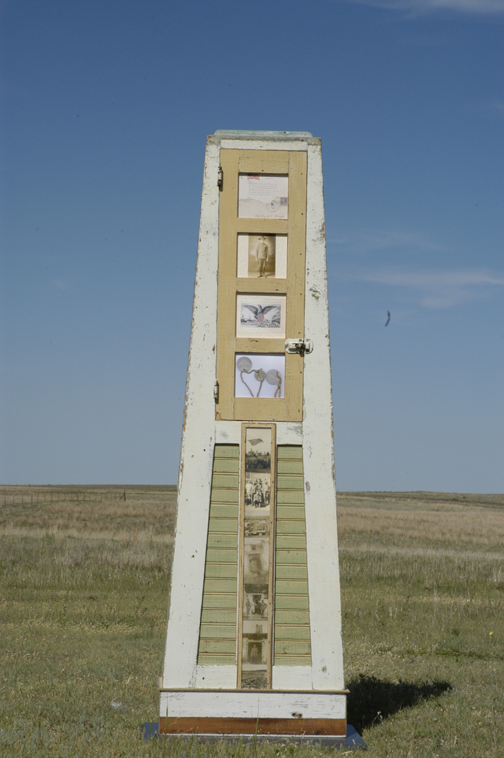
The only remaining porch post with any solid wood is now paired with a “newer” square profile post to support the Front Porch Conversations piece. The half windmill vane now serves as the front panel. Attic floorboards, brown paint showing through to green, frame out the case. Appie’s and Mona’s ceiling boards have become door panels. Some of the porch trim and Charlie’s Prince Albert cans top it all off.

Every year the blue “Wards” lettering on the pasture shed would fade a little more. Located near the ground the sheet metal panel with its blue sign made a good “rub-board” for cattle and roof runoff splattered the panel. To open up more of the shed for cattle, the sign section and companion panels are removed. A 1953 penny and a toy sheriff’s badge are discovered as the sheet metal is pried loose from the strapping boards. Stenciled instructions on the back of the sections show they were originally part of a Wards 1500 bushel granary that were flattened out and pressed into service as shed siding.
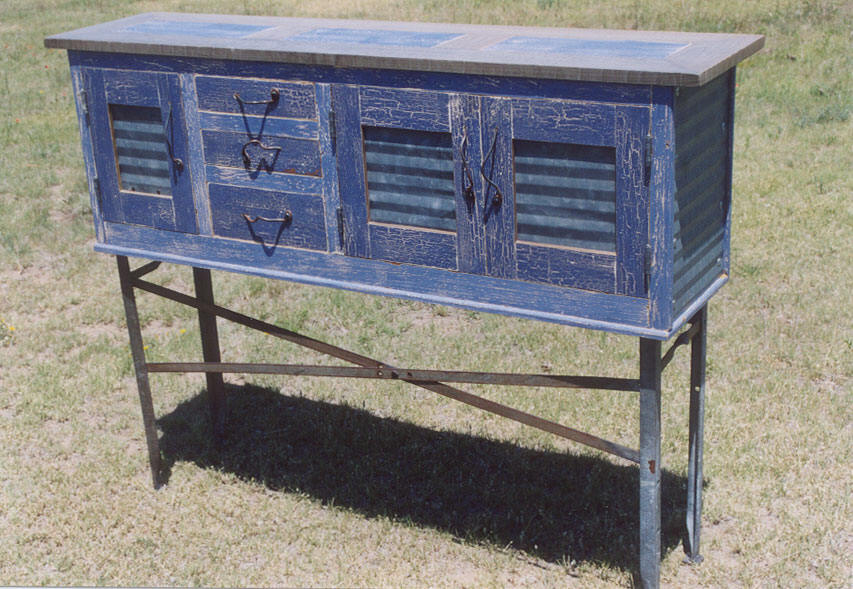
Cut free from their heavy locking-edge rolls, the galvanized metal now makes up the side and door panels on the Wards 1500 Tall Chest. The tall chest case lumber has been cut from salvage baseboard and door trim reclaimed from a once-grand, two-story, four-dormered house out west of Lipscomb, Texas. The original rose-pink paint shows through a post-salvage coat of blue milk paint. The rose room looks out on a wide porch, its once sturdy railing and posts slowly sagging to the ground. The view from the porch looks out across the remains of a large fenced yard and beyond to the dark elms lining the bend in the creek.
Pitchfork tines, found in the dirt of a wagon drive-through in an old barn, now serve as the door handle for the tall chest. The door frame is made from parts of a closet door in the bedroom above the rose room. The cabinet base is welded up from sections of Aermotor windmill vane stem angle iron. Electric fence wire binds the rod braces together.

Standing on legs of windmill vane stem angle, braced with light strapping from a wrecked windmill tower, the Iron Lady Sideboard is framed out of rose-pink salvaged interior trim, overpainted with a post-salvage coat of blue milk paint. Door and side panels are portions of a Wards 1500 Bushel granary. Short sections of copper REA wire have become door and drawer pulls.
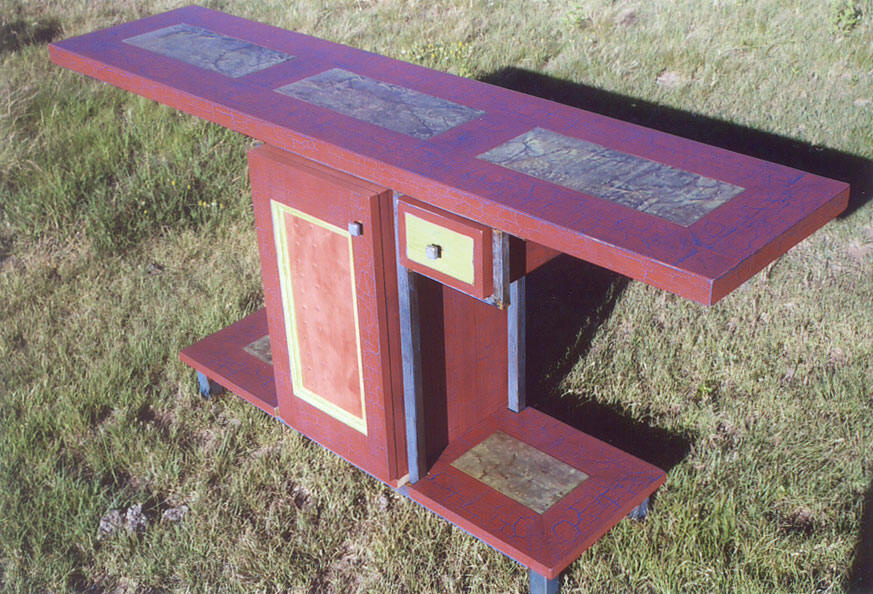
Old tar tins, flattened out and used for flashing on the floor of an open dormer porch, now have a third life as table top panels. Heavy yellow pine doorjamb sections make up the table frame. The original green paint shows through a coat of post-salvage red milk paint. The door panel is a section of security fencing made by the Tex Anchor Fence Company in Fort Worth. A baling wire wrapped bolt serves as the door pull.

Shot up, robbed for parts, and dumped on its back, the old J.I. Case threshing machine perched near a draw cutting down the caprock overlooking Palo Duro Creek. The years of work and weather had produced a rare rust patina. A section of the thresher shell graces the front panel on the Thresher’s Requiem. Bands and rivets now hold slide-gate sections together.
Side panels are beadboard reclaimed from the attic room in the old Moore homestead out east of Lipscomb, Texas on Wolf Creek. Post-salvage coats of milk paint cover the case. A bolt, in combination with two rod brackets from an old horse-drawn sulky rake, works now as a door pull. Inside, the drawer back plate is a mystery piece.

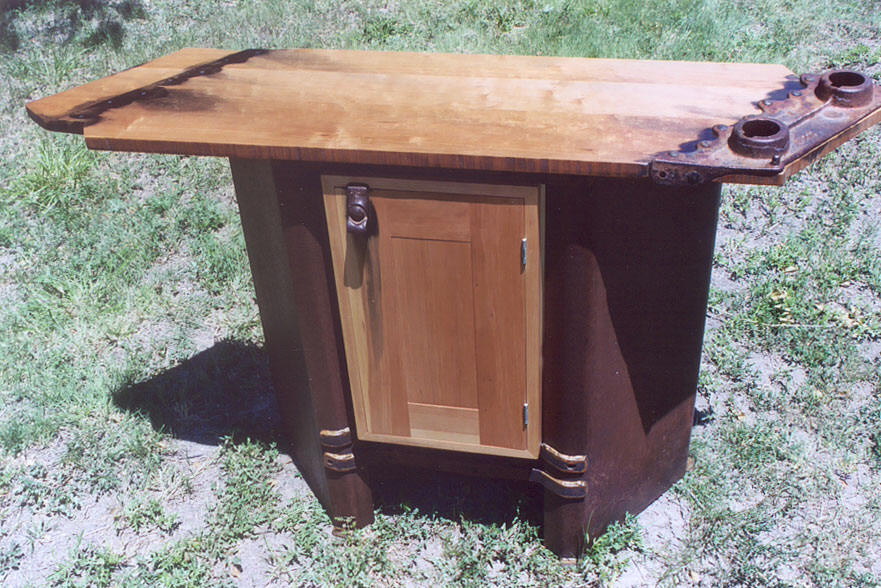
What sort of machinery the rusted sheet metal shroud had belonged to was a mystery. But the wonderfully-shaped steel end bracket suggested possibilities in combination with a slab of cherry. The bracket determined the shape of the Deering-Do Hall Table top. The door pull for the cherry cabinet originally was part of a International Harvester sulky rake. Plate steel, shaped for some unknown purpose, now makes up the table base.
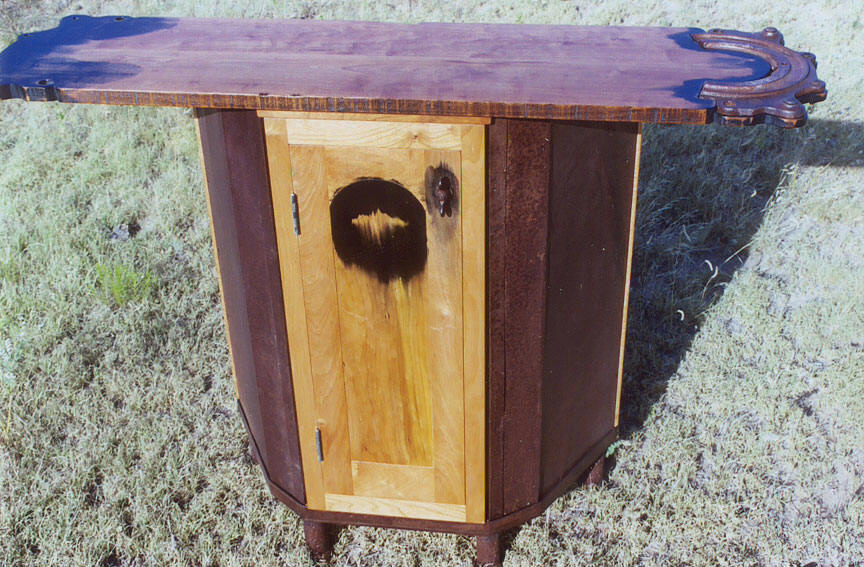
Beadboard from the ceiling in an upstairs bedroom in the old Dave Appel house on Willow Creek, combined with baseboard from an abandoned homestead on Commission Creek, now form the case and door frames of the McCormick Dreaming cabinet. Walnut, stored in the stacks for twenty years, is used for the cabinet base, door panels, and top. A mysterious McCormick-Deering/International Harvester part has been used to shape and bracket the top. Agitator fingers from an International planter plate work as door pulls. And a section of ’35 Chevy door panel, painted with pink milk paint and “altered” with a ball-peen hammer, is the “odd man out” door panel.

Out on the plains, the cottonwood tree shows where the water is located: a lone tree guarding a small spring or whole groves of cottonwoods along creeks and rivers. With the exception of a rare Methuselah tree, most cottonwoods have a life span of about 80 years. A small section of the weathered-out shell of a dead cottonwood giant serves as the door on Water Dog, the split halves joined by a “vein” of roof tin. Door and drawer pulls are brass spools from worn-out windmill checks. A mystery McCormick-Deering, International Harvester part tops off the cabinet.
Salvage lumber with two coats of post-salvage milk paint forms the cabinet case. Blue beadboard reclaimed from the porch ceiling on an open-air dormer now clads the side of Water Dog.

The cattleman built his bride a stately, two-story house with large dormers looking to the four directions. But he died young, leaving his wife alone on the Texas ranch. The lady refused to move to town, and instead raised her own cattle, broke her own horses, and managed just fine. She never learned to drive, but kept a shiny Lincoln Zephyr in the shed and hired neighbor boys to drive her the 30 miles to town. Later in her life, oil and gas were discovered on the land, assuring a steady succession of new Lincolns. She lived out her days on the ranch.
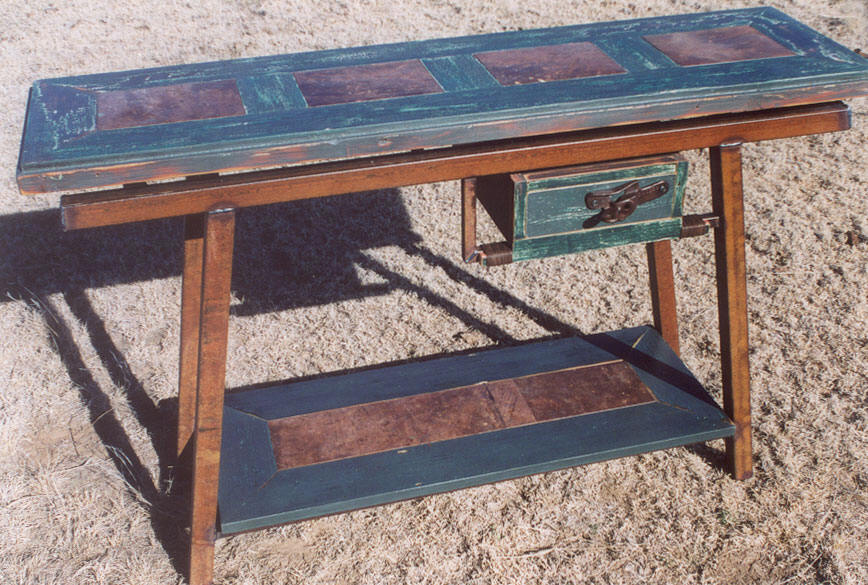
Today the grand old house is weathering down, and only the sounds of birds, oilfield pump jacks, and the wind are heard around the place. Bright blue interior trim, salvaged from around the stairway and covered with a post-salvage coat of red milk paint, makes up the top frame and case of the sofa table. Green flashing tin from an upstairs dormer porch, originally made out of flattened and soldered tar tins, is used for the framed panels. The table support frame is welded scrap from an oilfield location. Tank hatch bolts have become door and drawer pulls.
Due to all the June rains, Wolf Creek ran high and I had to wade at the crossing in order to get to the dead cottonwood on the north side. Twin fawns and I scared each other just before I got to the massive prone trunk and scattered limbs. Part of the main trunk and a smashed limb have become the main shell for Plains Rune. Aviation rivets and copper wire bind a crack. Rusted-out sheet metal, long buried next to a barn, sees the light of day as the door panel. Gold leaf shines through the rust holes. A piece of heavy gauge wire becomes the door pull.

Senior member of the machinery graveyard on our place, the burr grinder feed mill hadn’t seen use since Grandpa Bucher died in 1951. Patched, welded, and rusted, the grinder seemed to defy orderly disassembly. But one can of WD-40 and some not-so-gentle persuasion later, the odd assortment of knobs and wingnuts freed up.
The slide-gate housing, minus slide-gates and several pounds of cast iron, has been used to shape and stain the cherry wood top. A toothed ring that fed material to the burr rings has left its mark on the cherry door panel. Serving as the door pull is a wingnut that once set the spring tension. Sheet metal, pulled from a draw dump, now clads the hall table case. The bottom frame for the case is made from a single bed rail, cut and bent to shape. Legs are short sections of rusted oilfield gas line.
Used hard in the days of horse farming and robbed of various parts in the succeeding years, the gap-toothed hay rake was destined for the scrap metal yard. Some of the remaining spring steel teeth and special parts are given a second life on the Sulky-Rake Serving Table. The tines pierce the cherry tabletop and brace the scrap steel base. Door pulls were “rod-keepers” for the trip mechanism on the rake. A steel adjustment block works as the drawer pull.
Sheet metal scraps are used as side and door panels. Washtub bail fasteners now secure the tines. And the cherry door panel bears the stain imprint of a feed mill burr-ring.
With only a rafter and joist-tangle of its old flat roof remaining, the Dreyfoos School house had almost deteriorated past the point of any salvage. The brick exterior walls, complete with huge double-hung windows gave the illusion of a complete structure. But a glance through the hazy window glass showed utter ruin inside.
Once the center point for the small, remote community that gathered around the City Service gas booster station in the far eastern Texas Panhandle, Dreyfoos School had given a start to a generation of ranch and booster station children. As modern compressors replaced the booster station, the school closed.
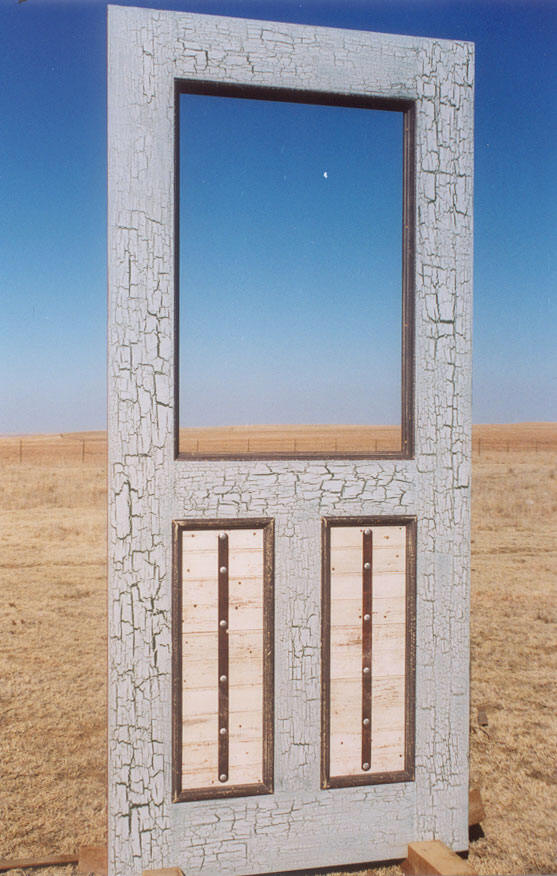
Security glass panes, fallen from rotten door frames, are rescued from the piles of floor debris and given a second chance as door and side panels for the Dreyfoos Looking Glass. Portions of transom window hardware that hung walking stick-like from the tilting walls have become door pulls. Milk paint colors approximate some of the color fragments found in the school ruins.
Even though the old house is weathering down and the porch columns are crumbling under the weight of the roof, the upstairs dormer porch still presents a panoramic view through the untrimmed yard trees—out over the rolling prairie and tree-lined creek bank. Before her death in 1949, did the lady rancher, many years a widow, sit out on the upstairs porch and think back to the early days when she and her English cowboy built the grand house near Wolf Creek in the Texas Panhandle? Did the tin flashing covering the porch floor pop and crack as she walked on it like it does now?
The quiet house can only tell part of the stories. Sections of the flashing, flattened tar tins soldered together, have become panels for the Southern View Sofa Table. Doorjambs and trim with a post-salvage coat of red milk paint are used for the table frame and cabinet. The door pull is an unknown part pulled from a burn pit. And the table base is constructed out of scrap tubing and structural bracing from an old oilfield location.

The old flooring boards, used as skip sheeting on the barn roof, are riddled with holes from the roofing nails and coated in a century’s worth of grime and dust. But once in twenty boards or so, a promising grain pattern can be seen through the dirt layer. Cleaned up, the boards are revealed to be longleaf, curly heart-pine. Edge-glued sections framed out with oak make up the case for the Over the Loft Hall Table. A piece of the roof tin that once was nailed to the skip sheeting now clads the ends of the table.
Log tongs, possibly once used for creosote-dipping fence posts, are buckled to the table ends. The center clevis for the tongs is now the door pull.
Bright southern light streamed through the attic window and lit up the green beadboard that covered the sloped ceiling and the walls. A barn owl came and went through the window, unhampered by screen or glass. The glazing had dried to dust, allowing the glass panes to drop out and break on the porch roof below. Cleaned of the soot layer left from years of kerosene lamps, some of the green beadboard has become the side panels for Attic Window Sentinel.
The green door panel is cut from the shell of a surplus military generator. The window section in the panel frames a rusted-out piece of feed mill sheet metal. Gold leaf provides the “back-lighting.” The door handle once served as a slide-gate handle on a burr grinder feed mill. Top “caps” are Oliver equipment bearing races. The case wood is painted with green and pink milk paint.

The scaly white paint, hard as flint, still clung to the lap siding where the porch roof had provided some protection. Pried from the wall, the backs of the boards showed longleaf pine almost as clear and clean as the day it was installed. The boards, along with the rest of the house had been hauled by wagon from the railhead at Canadian, Texas about 1900. With a coat of post-salvage black milk paint, some of the siding boards form the case sides for the Front Porch Gleaner. Doorjamb parts salvaged from the house form the case and door frame for the cabinet.
Half of a grain sieve from a pull-type Gleaner Baldwin combine has become the door panel. The door pull originally worked to expel hay out of the tines on a horse-drawn hay rake. A bale’s worth of baling wire wraps the handle.

Unused since the ‘40s, the burr-grinder feed mill stood its ground in the machinery graveyard. Rusted bolts and shafts gave little promise of freeing up enough for even a partial disassembly. With liberal use of WD-40 and lots of persuasion, the bell housing on the end of the shaft freed up. Cut from the back of the bell, the slide-gate bracket now crowns the cabinet door on the Burr Gate Side Table.
The gates, set end-to-end, determine the shape of the top and have been allowed to stain the cherry wood before being bolted and riveted to one end. Scrap strap iron binds the cherry table base. A rusted scrap of tin provided the door panel. And an end-gate wing nut works as the door pull.

We have not yet posted the story on this piece…

Nail by nail, and in turn, board by board, the skeleton of the old homestead along Wolf Creek is gradually exposed to the light. Halfway down a wall, as a board comes off, a thin rectangle flashes and floats to the ground. Dust is blown off, revealing a WWI vintage negative with a ghostly image of a soldier in gas mask garb.
A few miles back southeast, a pool of dark spring water is hidden by steep dirt banks and a dense halo of young cottonwoods. Light filtering through the leaves catches on an occasional patch of off-white barely protruding out of the sediment walls—buffalo bones, the remains of the last remnants of the Great Plains herds.
A mile on up the draw where the land tops out, the old wooden barn finally gives in to the Panhandle wind and termites. As the last framing members come down, the long row of over-sized nails used for hanging harness is saved from the burn pit.
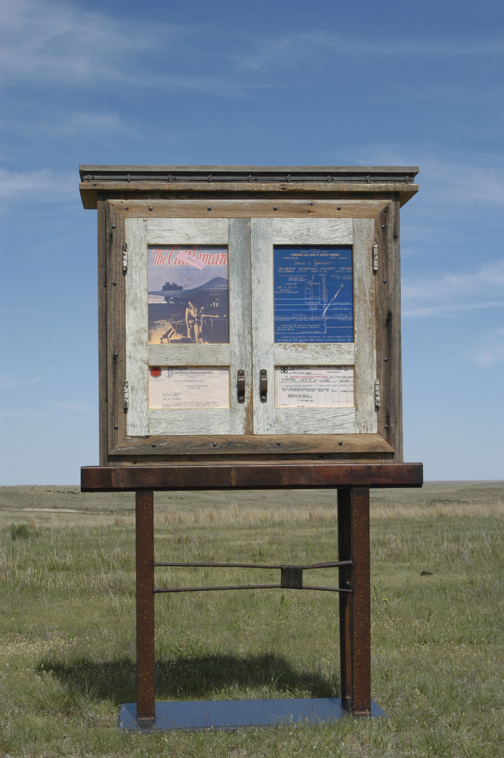
One of those harness nails has become the door pull for Country of Bones Wall Cabinet. The negative and a buffalo bone, along with its “marrow” of nails from the homestead, make up the door panel. The case and door are constructed of red gum wood.


